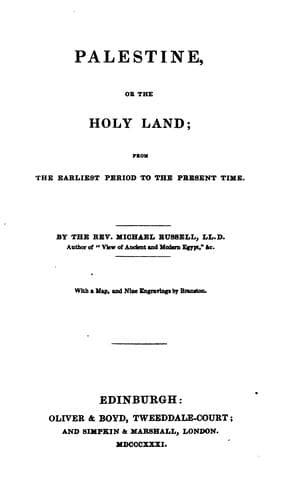
Palestine, or, the Holy Land: From the Earliest Period to the Present Time — John Shaqi
Palestine, or, the Holy Land: From the Earliest Period to the Present TimeRussell, Michael
History
Palestine, or, the Holy Land: From the Earliest Period to the Present Time
Russell, Michael
Palestine -- Description and travel; Palestine -- History
We find, in the first chapter of the book of Numbers, a command issued by
the authority of Heaven to separate the tribe now mentioned from the rest
of their brethren, and not to enrol them among those who were to engage in
war. It was determined, on similar grounds, that the Levites were to have
no inheritance in the land like the other tribes, but were to receive from
their kinsmen, in name of maintenance, a tenth part of the gross produce
of their fields and vineyards. The occupations for which they were set
apart were altogether incompatible with the pursuits of agriculture or the
feeding of cattle. It was deemed expedient, therefore, that they should be
relieved from the cares and toil connected with the possession of
territorial estates, and devote their whole attention to the service of
the altar and the instruction of the people.
To effect these wise purposes, it was necessary that the members of this
learned body should not be confined to one particular district, but that
they should be distributed among all the other tribes, according to the
extent of their several inheritances and the amount of their population.
With this view the law provided that a certain number of cities should be
set apart for them, together with such a portion of soil as might seem
requisite for their comfort and more immediate wants. "Command the
children of Israel, that they give unto the Levites, of the inheritance of
their possession, cities to dwell in; and ye shall give unto the Levites
suburbs for the cities round about them. And ye shall measure from without
the city, on the east side, two thousand cubits, and on the south side two
thousand cubits, and on the west side two thousand cubits, and on the
north side two thousand cubits; and the city shall be in the midst: this
shall be to them the suburbs of the cities. So all the cities which ye
shall give to the Levites shall be forty and eight cities; them shall ye
give with their suburbs."[30]
It was not till after the conquest and division of Canaan that the
provisions of this enactment were practically fulfilled. When the other
tribes were settled in their respective possessions, the children of Levi
reminded Joshua of the arrangement made by his predecessor, and claimed
cities to dwell in, and suburbs for their cattle. The justice of their
appeal being admitted, the Levitical stations were distributed as
follows,--
Cities
In the tribes of Judah, Simeon, and Benjamin 13
In Ephraim, Dan, and the half-tribe of Manasseh 10
In the other half-tribe of Manasseh, Issachar,
Asher, and Naphtali 13
In Zebulun, Reuben, and Gad 12
--
48
Public-domain text, read in full here on John Shaqi.
Reviews
Reviews
No reviews yet
Be the first to share your thoughts on this work.
Join the Discussion
Join the discussion
Sign in to leave a comment or review.
Sign InorCreate an account