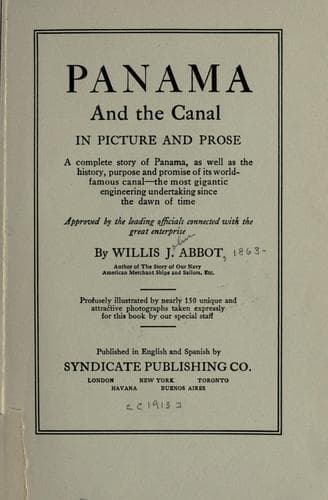
Panama and the Canal in Picture and ProseAbbot, Willis J. (Willis John)
History
Panama and the Canal in Picture and Prose
Abbot, Willis J. (Willis John)
Panama Canal (Panama) -- History
It is one of the traditions of the town that a tramp steamer, commanded
by a German, came plowing in from the sea one morning and, passing
without attention the docks of Colon, went gaily on up Limon Bay until
she ran smack into the land. Being jeered at for his unusual method of
navigation the captain produced his charts. “That town is Colon? No? Is
it not so? Vell dere are two towns. My port is Colon. Cristobal comes
first. I pass it. I go on to Colon and by thunder dere is no Colon.
Nothing but mud.” It is recorded that the skipper’s explanation was
accepted and that he was acquitted of wilfully casting away his vessel.
[Illustration: “PALMS WHICH BLEND WITH THE SEA”]
We reach Colon where lie the docks of the Royal Mail in the early
morning. To the right as we steam into Limon Bay is the long breakwater
of Toro Point extending three miles into the Caribbean, the very first
Atlantic outpost of the canal. For it was necessary to create here a
largely artificial harbor, as Limon Bay affords no safe anchorage when
the fierce northers sweep down along the coast. In the early days of
Colon, when it was the starting point of the gold seekers’ trail to
Panama, ships in its harbor were compelled to cut and run for the safer,
though now abandoned, harbor of Porto Bello some twenty miles down the
coast. That condition the great breakwater corrects. From the ship one
sees a line of low hills forming the horizon with no break or
indentation to suggest that here man is cutting the narrow gate between
the oceans for the commerce of the nations to pass. The town at a
distance is not unprepossessing. White houses with red roofs cluster
together on a flat island scarcely above the water, and along the sea
front lines of cocoanut palms bend before the breeze. No other tree
seems so fitly to blend with a white beach and blue sea as this palm.
Its natural curves are graceful and characteristic and in a stiff breeze
it bows and sways and rustles with a grace and a music all its own.
But the picturesqueness of Colon does not long survive a closer
approach. The white houses are seen to be mere frame buildings of the
lightest construction which along the seafront stand out over the water
on stilts. No building of any distinction meets the eye, unless it be
the new Washington Hotel, a good bit of Moorish architecture, owned and
conducted by the Panama Railroad which in turn is owned by the United
States. The activities of Uncle Sam as a hotel keeper on the Isthmus
will be worth further attention.
[Illustration: COLON IN 1884
The author counted twelve ocean liners one day at the docks now standing
at this spot]
Public-domain text, read in full here on John Shaqi.
Reviews
Reviews
No reviews yet
Be the first to share your thoughts on this work.
Join the Discussion
Join the discussion
Sign in to leave a comment or review.
Sign InorCreate an account