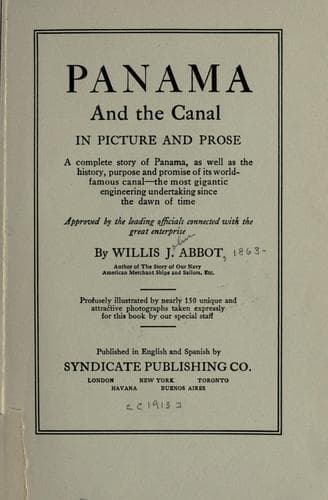
Panama and the Canal in Picture and Prose — John Shaqi
Panama and the Canal in Picture and ProseAbbot, Willis J. (Willis John)
History
Panama and the Canal in Picture and Prose
Abbot, Willis J. (Willis John)
Panama Canal (Panama) -- History
As we warp into the dock we observe that Colon is a seaport of some
importance already. The day I reached there last I counted six British,
two German, one French and three American steamships. The preponderance
of British flags was the first thing to catch the eye; and somehow the
feeling that, except for the Royal Mail ship, all the vessels over which
they were waving were owned by American capital was not a little
humiliating. It is quite probable that in the course of the year every
foreign flag appears at Cristobal-Colon, for the ocean tramp ships are
ever coming and going. In time, too, the docks, which are now rather
rickety, will be worthy of the port, for the government is building
modern and massive docks on the Cristobal side of the line.
At present however one lands at Colon, which has the disadvantage of
depositing you in a foreign country with all the annoyances of a custom
house examination to endure. Though your destination is the Canal Zone,
only a stone’s throw away, every piece of baggage must be opened and
inspected. The search is not very thorough, and I fancy the Panama
tariff is not very comprehensive, but the formality is an irritating
one. Protective tariffs will never be wholly popular with travelers.
The town which greets the voyager emerging from the cool recesses of the
steamship freight house looks something like the landward side of
Atlantic City’s famous board walk with the upper stories of the hotels
sliced off. The buildings are almost without exception wood, two stories
high, and with wooden galleries reaching to the curb and there supported
by slender posts. It does not look foreign--merely cheap and tawdry.
Block after block the lines of business follow each other in almost
unvarying sequence. A saloon, a Chinese shop selling dry goods and
curios, a kodak shop with curios, a saloon, a lottery agency, another
saloon, a money-changer’s booth, another saloon and so on for what seems
about the hottest and smelliest half mile one ever walked. There is no
“other side” to the street, for there run the tracks of the Panama
railroad, beyond them the bay, and further along lies the American town
of Cristobal where there are no stores, but only the residences and work
shops of Canal workers. Between Cristobal and tinder box Colon is a wide
space kept clear of houses as a fire guard.
Colon’s population is as mixed as the complexions of its people. It must
be admitted with regret that pure American names are most in evidence on
the signboards of its saloons, and well-equipped students of the social
life of the town remark that the American vernacular is the one usually
proceeding from the lips of the professional gamblers. Merchandising is
in the main in the hands of the Chinese, who compel one’s admiration in
the tropics by the intelligent way in which they have taken advantage of
the laziness of the natives to capture for themselves the best places in
the business community.
Public-domain text, read in full here on John Shaqi.
Reviews
Reviews
No reviews yet
Be the first to share your thoughts on this work.
Join the Discussion
Join the discussion
Sign in to leave a comment or review.
Sign InorCreate an account