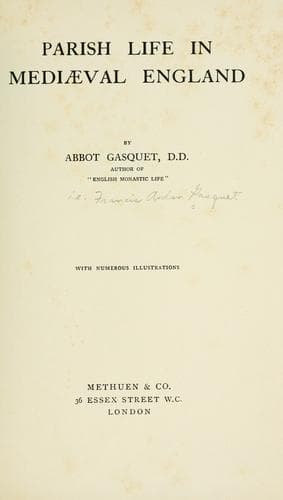
Parish life in mediæval EnglandGasquet, Francis Aidan
History
Parish life in mediæval England
Gasquet, Francis Aidan
England -- Church history -- 1066-1485; England -- Social life and customs -- 1066-1485
This claim, there can be no doubt, was fully accepted and carried
out. If a rector was for some reason or other non-resident, by law
his charity or “hospitality” had to be administered either by the
curate who served the church, or by a resident proctor appointed for
the purpose. In acknowledgment of this obligation, in the wills of
the period we find the clergy directing money to be paid by their
executors to the poor of the parishes which they had served. Thus
William Sheffield, Dean of York, who died in 1496, after arranging that
this distribution should be made in proportion to the time during which
he had held each benefice, adds: “For the goods of the Church are the
property of the poor and therefore the conscience is heavily burdened
in the spending of the goods of the Church. For badly spending them
Jesus have mercy.”
In the record of the visitation of churches in the diocese of Exeter,
in 1440, there are many references to the “hospitality” kept by the
clergy. In one instance the rector is praised for having rebuilt his
chancel and added two good rooms to the rectory, one for himself
and one for the purposes of hospitality. In another there is a note
“that, from time immemorial to the day of the present rector, great
hospitality had been maintained, and the goods of the church had been
made the property of the sick and the poor,” but that this had ceased.
It seems to us, indeed, almost strange in these days to see what was
the teaching of the mediæval Church about the claims of the poor, and
to remember that this was not the doctrine of some rhetorical and
irresponsible preacher, but of such a man of law and order as was
the great Canonist Lyndwood. There can be no doubt that the proceeds
of ecclesiastical benefices were recognised in the Constitutions of
legates and archbishops as being in fact, as well as in theory, the
_eleemosynæ_, the _spes pauperum_--the alms and the hope of the poor.
Those ecclesiastics who consumed the revenues of their cures on other
than necessary and fitting purposes were declared to be “defrauders of
the rights of God’s poor,” and “thieves of Christian alms intended for
them;” whilst the English canonists and legal professors, who glossed
these provisions of the Church law, gravely discussed the ways in which
the poor of a parish could vindicate their right--_right_, they call
it--to a share in the ecclesiastical revenues of their Church.
Public-domain text, read in full here on John Shaqi.
Reviews
Reviews
No reviews yet
Be the first to share your thoughts on this work.
Join the Discussion
Join the discussion
Sign in to leave a comment or review.
Sign InorCreate an account