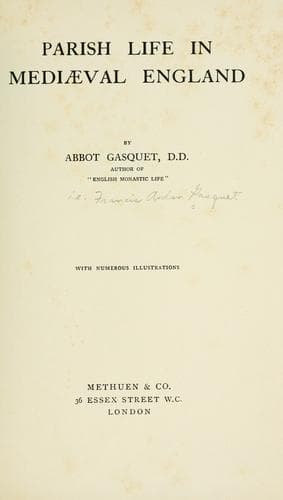
Parish life in mediæval EnglandGasquet, Francis Aidan
History
Parish life in mediæval England
Gasquet, Francis Aidan
England -- Church history -- 1066-1485; England -- Social life and customs -- 1066-1485
Various “oblations,” moreover, were apparently made to the parson
regularly. At Folkestone, for example, according to the _Valor
Ecclesiasticus_, an oblation of 5_d._ was made to the priest each
Sunday. Lyndwood lays down, as the law regarding regular oblations
“made on Sundays and Festivals, etc.,” that they belong to the priest
who had the cure of souls, “whose duty it was to pray for the sins
of the people.” Other priests, who might be attached to the church,
had no claims upon them except by agreement, as those who make the
offering are not their parishioners. Oblations of this kind were not
always voluntary, and they could be recovered for the clergyman by the
bishop, as, for instance, when they were made according to a previous
agreement, or promise, or in any special need of the Church, as when
the minister had not sufficient to support himself properly; or when
such offering was made according to established custom.
Bishop Quevil, in the Synod of Exeter, states what were the
long-established customs in the English Church as to regular oblations.
Every adult parishioner above the age of fourteen years had to make an
offering four times a year, at Christmas and Easter, on the patronal
feast, and on the dedication feast of his parish church, or, according
to custom, on All Saints’ day. The bishop also desired that the people
of his diocese should be persuaded to bring Pentecost offerings also to
their parish churches, or at least to send them to their parsons. To
induce them so to do, special indulgences granted to all benefactors
of churches were to be published on each of the three Sundays before
the feast, and all such offerings were to be taken to the place where
the Whit-Sunday processions assemble. Bishop Rigaud de Asserio, of
Winchester, in 1321, makes the same claim as to the regular four
payments, but puts the age at eighteen, and even then only claims the
oblation as a right in the case of those possessing some movables of
their own. In some instances, apparently, a portion of the offerings
made for any special object was by custom given to the priest for his
own use, as a well-understood tax. This, for example, was the case at
St. Augustine’s church at Hedon, in the East Riding of Yorkshire, where
in the fifteenth century “a third of the oblations to the Holy Cross
was given to the Vicar.”
The rectory house, which was situated near to the church, would no
doubt in these days be considered very poor. A living-room and a
bedroom, with perhaps a room in which to exercise “hospitality,” with
some necessary offices and a kitchen, were all that, as far as can be
ascertained, constituted the dwelling-place of the parochial priest.
“Religious feelings,” says Dr. Rock, “sweetened the homeliness of
everyday life.” Over the parlour chimneypiece in the vicarage house
at Besthorpe, Norfolk, built by Sir Thomas Downyng, priest, are these
lines--
“All you that sitt by thys fire warmyng
Pray for the sowle of Sir Jhon Downyng.”
Public-domain text, read in full here on John Shaqi.
Reviews
Reviews
No reviews yet
Be the first to share your thoughts on this work.
Join the Discussion
Join the discussion
Sign in to leave a comment or review.
Sign InorCreate an account