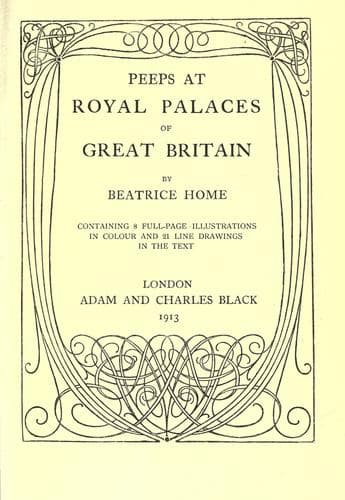
Peeps at Royal Palaces of Great BritainHome, Beatrice
History
Peeps at Royal Palaces of Great Britain
Home, Beatrice
Palaces -- Great Britain
Before the palace was erected a castle stood close to the site of the
present building. It had long been a possession of the Earls of Fife,
till in the fourteenth century it descended to an heiress who had
no children. She bestowed the castle upon Robert Duke of Albany, the
brother of the inefficient King Robert III. Upon Albany rests the
dreadful charge of murdering his young nephew, the Duke of Rothesay,
by starving him to death in the castle at Falkland. Rothesay was young
and wild, and had annoyed his uncle by getting himself made Guardian
of the Realm, a post desired by Albany. After involving Scotland in
war with England, due to his imprudence in jilting the daughter of
the Earl of March, who succeeded in obtaining an English army in his
support, Rothesay was captured on his way to St. Andrews by his
uncle, who, it is said, had his father's authority to do so. Taken
to Falkland Castle the Prince never came out alive, dying of slow
starvation according to one account, and of dysentery by another.
It is evident that Albany was suspected of murder, for he took the
trouble to be officially acquitted of any part in his death. Only
grassy mounds now indicate the position of this castle, which
must have been, according to the investigations of Lord Bute, of
considerable extent.
The execution of Albany's son as a traitor made Falkland Crown
property. The palace began to be erected by James II., but its chief
builder was James IV., who spent large sums of money on the work, and
much enjoyed the sport to be obtained in the neighbourhood. His son,
James V., was often there, though apparently not for long periods at a
time. He was the only monarch to die there, a sad event which occurred
at the early age of thirty. In despair at the rout of his army at
Solway Moss, the young monarch refused all consolation, and just
seemed to wait for death, though there were no apparent signs of it
upon him. Not even the news brought to him from Linlithgow of the
birth of a daughter could cheer him. Merely saying the often quoted
words, "It came wi' a lass and will pass wi' a lass," he turned his
head to the wall and died a few days later.
No events of importance took place at Falkland during Mary Queen of
Scots' brief reign, though she visited it occasionally. Her son,
James VI., was much attached to it, on account of the good hunting it
afforded. On one occasion he was nearly captured there by the reckless
Francis Earl of Bothwell, who made one of his many attempts to seize
the King. But on this midnight attack he was unsuccessful, for he and
his party were forced to flee when the artillery of the palace was
turned against them. They were not pursued, as they had taken the
precaution to take possession of all the horses.
Public-domain text, read in full here on John Shaqi.
Reviews
Reviews
No reviews yet
Be the first to share your thoughts on this work.
Join the Discussion
Join the discussion
Sign in to leave a comment or review.
Sign InorCreate an account