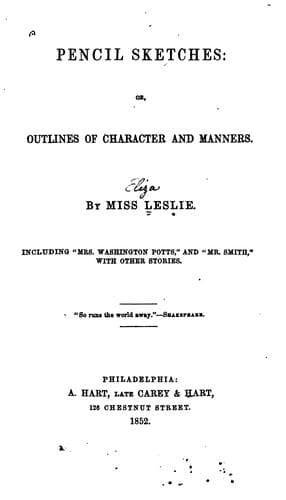
Pencil Sketches; or, Outlines of Character and MannersLeslie, Eliza
General
Pencil Sketches; or, Outlines of Character and Manners
Leslie, Eliza
Humorous stories; Short stories, American; United States -- Social life and customs -- 19th century -- Fiction
"No--no," said Mr. Smith, stopping her apprehensively; "I would rather
not intrude any farther upon his kindness."
"I declare you are the shame-facedest man I ever saw in my life. Well,
then, you can walk about, and look at the trees and bushes. There's a
fine large buttonwood, and there's a sassafras; or you can go to the
edge of the bank and look at the river and watch how the tide goes down
and leaves the splatter-docks standing in the mud. See how thick they
are at low water--I wonder if you couldn't count them. And may be
you'll see a wood-shallop pass along, or may be a coal-barge. And who
knows but a sturgeon may jump out of the water, and turn head over heels
and back again--it's quite a handsome sight!"
Good Mr. Smith did as he was bidden, and walked about and looked at
things, and probably counted the splatter-docks, and perhaps saw a fish
jump.
"It's all bashfulness--nothing in the world but bashfulness," pursued
Mrs. Quimby; "that's the only reason Mr. Smith don't talk."
"For my part," said a very elegant looking girl, "I am perfectly willing
to impute the taciturnity of Mr. Smith (and that of all other silent
people) to modesty. But yet I must say, that as far as I have had
opportunities of observing, most men above the age of twenty have
sufficient courage to talk, if they know what to say. When the head is
well furnished with ideas, the tongue cannot habitually refrain from
giving them utterance."
"That's a very good observation," said Mrs. Quimby, "and suits _me_
exactly. But as to Mr. Smith, I do believe it's all bashfulness with
him. Between ourselves (though the British consul warrants him
respectable) I doubt whether he was ever in such genteel society before;
and may be he thinks it his duty to listen and not to talk, poor man.
But then he ought to know, that in our country he need not be afraid of
nobody: and that here all people are equal, and one is as good as
another."
"Not exactly," said the young lady, "we have in America, as in Europe,
numerous gradations of mind, manners, and character. Politically we are
equal, as far as regards the rights of citizens and the protection of
the laws; and also we have no privileged orders. But individually it is
difficult for the refined and the vulgar, the learned and the ignorant,
the virtuous and the vicious to associate familiarly and
indiscriminately, even in a republic."
The old lady looked mystified for a few moments, and then proceeded--"As
you say, people's different. We can't be hail fellow well met, with Tom,
Dick, and Harry--but for my part I think myself as good as anybody!"
No one contradicted this opinion, and just then a gentleman came up and
said to the young lady--"Miss Atwood, allow me to present you with a
sprig of the last wild roses of the season. I found a few still
lingering on a bush in a shady lane just above."
"'I bid their blossoms in my bonnet wave,'"
said Miss Atwood--inserting them amid one of the riband bows.
Public-domain text, read in full here on John Shaqi.
Reviews
Reviews
No reviews yet
Be the first to share your thoughts on this work.
Join the Discussion
Join the discussion
Sign in to leave a comment or review.
Sign InorCreate an account