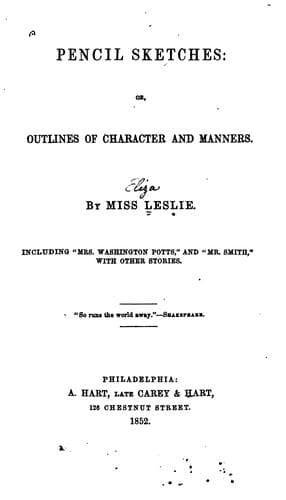
Pencil Sketches; or, Outlines of Character and MannersLeslie, Eliza
General
Pencil Sketches; or, Outlines of Character and Manners
Leslie, Eliza
Humorous stories; Short stories, American; United States -- Social life and customs -- 19th century -- Fiction
The whole company were amazed into a silence of some moments: after
which there was a general buzz of favourable remark; Captain Cheston
shook hands with him, and all the gentlemen pressed forward to be more
particularly introduced to Lord Huntingford.
"Dear me!" said Aunt Quimby; "to think that I should have been so
sociable with a lord--and a real one too--and to think how he drank tea
at Billy Fairfowl's in the back parlour, and ate bread and butter just
like any other man--and how he saved Jane, and picked up Johnny--I
suppose I must not speak to you now, Mr. Smith, for I don't know how to
begin calling you my lord. And you don't seem like the same man, now
that you can look and talk like other people: and (excuse my saying so)
even your dress looks genteeler."
"Call me still Mr. Smith, if you choose," replied Lord Huntingford; and,
turning to Captain Cheston, he continued--"Under that name I have had
opportunities of obtaining much knowledge of your _unique_ and
interesting country:--knowledge that will be useful to me all the
remainder of my life, and that I could not so well have acquired in my
real character."
He then explained, that being tired of travelling in Europe, and having
an earnest desire to see America thoroughly, and more particularly to
become acquainted with the state of society among the middle classes
(always the truest samples of national character), he had, on taking his
passage in one of the Liverpool packets, given his name as Smith, and
put on the appearance of a man in very common life, resolving to
preserve his incognito as long as he could. His object being to observe
and to listen, and fearing that if he talked much he might inadvertently
betray himself, he endeavoured to acquire a habit of taciturnity. As is
frequently the case, he rather overdid his assumed character: and was
much amused at perceiving himself rated somewhat below mediocrity, and
regarded as poor Mr. Smith.
"But where is that Baron fellow?" said Mrs. Quimby; "I dare say he has
sneaked off and taken the railroad himself, while we were all busy about
Lord Smith."
"He has--he has!" sobbed Miss Bentley; who in spite of her grief and
mortification, had joined the group that surrounded the English
nobleman; "and he has run away with my beautiful diamond ring."
"Did he steal it from your finger?" asked Aunt Quimby, eagerly; "because
if he did, you can send a constable after him."
"I shall do no such thing," replied Matilda, tartly; then turning to her
mother she added, "It was when we first went to walk by the river side.
He took my hand and kissed it, and proposed exchanging rings--and so I
let him have it--and he said he did not happen to have any ring of his
own about him, but he would give me a magnificent one that had been
presented to him by some emperor or king."
"Now I think of it," exclaimed Mrs. Bentley, "he never gave me back my
gold essence-bottle with the emerald stopper."
Public-domain text, read in full here on John Shaqi.
Reviews
Reviews
No reviews yet
Be the first to share your thoughts on this work.
Elsewhere in the archive
Join the Discussion
Join the discussion
Sign in to leave a comment or review.
Sign InorCreate an account