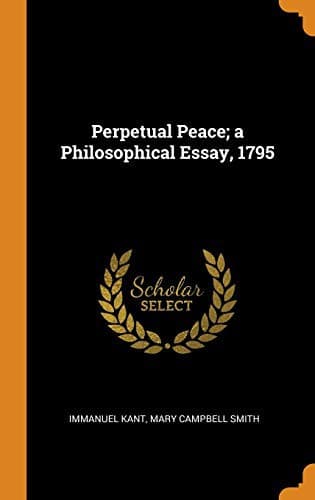
Perpetual Peace: A Philosophical EssayKant, Immanuel
PhilosophyPhilosophy
Perpetual Peace: A Philosophical Essay
Kant, Immanuel
Peace
The Peace Society are not of this opinion: they greatly doubt that a
war may be right, and they rarely fail to take their doubts to the
tribunal of Scripture. Their efforts are well meant, this piety may
be genuine enough; but a text is rarely a proof of anything, and in
any case serves one man in as good stead as another. We remember that
“the devil can cite Scripture for his purpose.” This unscientific
method of proof or persuasion has ever been widely popular. It is
a serious examination of the question that we want, a more careful
study of its actual history and of the possibilities of human nature;
less vague, exaggerated language about what ought to be done, and a
realisation of what has been actually achieved; above all, a clear
perception of what may fairly be asked from the future.
It used to be said—is perhaps asserted still by the war-lovers—that
there was no path to civilisation which had not been beaten by the
force of arms, no height to which the sword had not led the way. The
inspiration of war was upon the great arts of civilisation: its hand
was upon the greatest of the sciences. These obligations extended
even to commerce. War not only created new branches of industry, it
opened new markets and enlarged the old. These are great claims,
according to which war might be called the moving principle of
history. If we keep our eyes fixed upon the history of the past, they
seem not only plausible: they are in a great sense true. Progress
did tread at the heels of the great Alexander’s army: the advance of
European culture stands in the closest connection with the Crusades.
But was this happy compensation for a miserable state of affairs not
due to the peculiarly unsocial conditions of early times and the
absence of every facility for the interchange of ideas or material
advantages? It is inconceivable that now-a-days[106] any aid to the
development of thought in Europe should come from war. The old
adage, in more than a literal sense, has but too often been proved
true:—“Inter arma, Musae silent.” Peace is for us the real promoter
of culture.
[106] The day is past, when a nation could enjoy the exclusive
advantages of its own inventions. Vattel naively recommends that
we should keep the knowledge of certain kinds of trade, the
building of war-ships and the like, to ourselves. Prudence, he
says, prevents us from making an enemy stronger and the care of
our own safety forbids it. (_Law of Nations_, II. Ch. I. § 16.)
Public-domain text, read in full here on John Shaqi.
Reviews
Reviews
No reviews yet
Be the first to share your thoughts on this work.
Join the Discussion
Join the discussion
Sign in to leave a comment or review.
Sign InorCreate an account