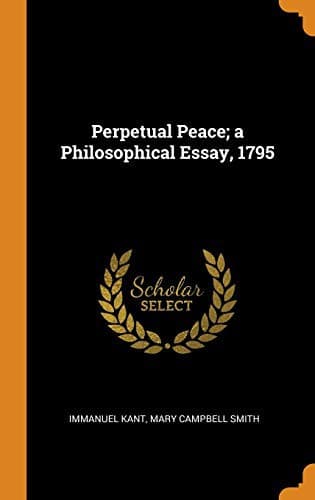
Perpetual Peace: A Philosophical Essay — John Shaqi
Perpetual Peace: A Philosophical EssayKant, Immanuel
PhilosophyPhilosophy
Perpetual Peace: A Philosophical Essay
Kant, Immanuel
Peace
We have to endeavour to take an intermediate course between
uncritical praise and wholesale condemnation, between extravagant
expectation and unjustifiable pessimism. War used to be the rule: it
is now an overwhelming and terrible exception—an interruption to the
peaceful prosperous course of things, inflicting unlimited suffering
and temporary or lasting loss. Its evils are on the surface, apparent
to the most unthinking observer. The day may yet dawn, when Europeans
will have learned to regard the force of arms as an instrument for
the civilisation of savage or half-savage races, and war within
their continent as civil war, necessary and justifiable sometimes
perhaps, but still a blot upon their civilisation and brotherhood as
men. Such a suggestion rings strangely. But the great changes, which
the roll of centuries has marked, once came upon the world not less
unexpectedly. How far off must the idea of a civil peace have seemed
to small towns and states of Europe in the fifteenth century! How
strange, only a century ago, would the idea of applying steam power
or electrical force have seemed to ourselves! Let us not despair. War
has played a great part in the history of the world: it has been ever
the great architect of nations, the true mother of cities. It has
justified itself to-day in the union of kindred peoples, the making
of great empires. It may be that one decisive war may yet be required
to unite Europe. May Europe survive that struggle and go forward
fearlessly to her great future! A peaceful future that may not be. It
must never be forgotten that war is sometimes a moral duty, that it
is ever the natural sequence of human passion and human prejudice. An
unbroken peace we cannot and do not expect; but it is this that we
must work for. As Kant says, we must keep it before us as an ideal.
TRANSLATION[107]
“PERPETUAL PEACE”[108]
[107] The text used in this translation is that edited by
Kehrbach. [Tr.]
[108] I have seen something of M. de St. Pierre’s plan for
maintaining perpetual peace in Europe. It reminds me of an
inscription outside of a churchyard, which ran “_Pax Perpetua._
For the dead, it is true, fight no more. But the living are of
another mind, and the mightiest among them have little respect
for tribunals.” (Leibniz: _Letter to Grimarest_, quoted above, p.
37, note 44.) [Tr.]
Public-domain text, read in full here on John Shaqi.
Reviews
Reviews
No reviews yet
Be the first to share your thoughts on this work.
Join the Discussion
Join the discussion
Sign in to leave a comment or review.
Sign InorCreate an account