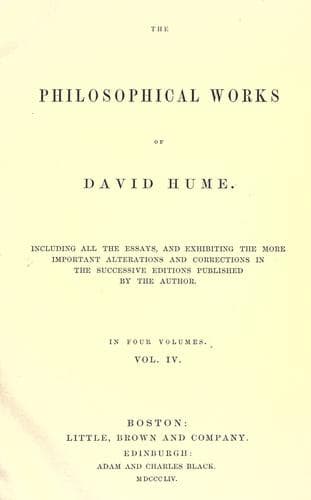
Philosophical Works, v. 1 (of 4): Including All the Essays, and Exhibiting the More Important Alterations and Corrections in the Successive Editions Published by the AuthorHume, David
PhilosophyPhilosophy
Philosophical Works, v. 1 (of 4): Including All the Essays, and Exhibiting the More Important Alterations and Corrections in the Successive Editions Published by the Author
Hume, David
Knowledge, Theory of; Philosophy, English -- 18th century
[19] It is necessary to explain this circumstance. I had been writing
on Mr Hume's table, during his absence, an answer to a letter I had
just received. He came in, very anxious to know what I had been
writing, and hardly able to contain himself from desiring to read it.
I closed my letter, however, without showing it him; when, as I was
putting it into my pocket, he asked me for it eagerly, saying he would
send it away on the morrow, being post-day. The letter lay on the
table. Lord Newnham came in. Mr Hume went out of the room for a moment,
on which I took the letter up again, saying I should find time to send
it the next day. Lord Newnham offered to get it inclosed in the French
ambassador's packet, which I accepted. Mr Hume re-entered the moment
his Lordship had inclosed it, and was pulling out his seal. Mr Hume
officiously offered his own seal, and that with so much earnestness,
that it could not well be refused. The bell was rung, and Lord Newnham
gave the letter to Mr Hume's servant, to give it to his own, who waited
below with the chariot, in order to have it sent to the ambassador.
Mr Hume's servant was hardly got out of the room, but I said to
myself, I'll lay a wager the master follows. He did not fail to do as
I expected. Not knowing how to leave Lord Newnham alone, I staid some
time before I followed Mr Hume. I said nothing; but he must perceive
that I was uneasy. Thus, although I have received no answer to my
letter, I doubt not of its going to hand; but I confess, I cannot help
suspecting it was read first.--Mr ROUSSEAU.
[20] It appears from what he wrote to me afterwards, that he was
very well satisfied with this letter, and that he thought of it very
well.--Mr ROUSSEAU.
[21] My answer to this is contained in Mr Rousseau's own letter of the
22d of March; wherein he expresses himself with the utmost cordiality,
without any reserve, and without the least appearance of suspicion.--Mr
HUME.
[22] All this hangs upon the fable he had so artfully worked up, as I
before observed.--Mr HUME.
[23] I had only one such opportunity with his governante, which was
on their arrival in London. I must own it never entered into my
head to talk to her upon any other subject than the concerns of Mr
Rousseau.--Mr HUME.
[24] See Mr d'Alembert's declaration on this head, annexed to this
narrative.
[25] Mr Rousseau declares himself to have been fatigued with the visits
he received; ought he therefore to complain that Mr d'Alembert, whom he
did not like, did not importune him with his?--Mr HUME.
[26] This _false friend_ is, undoubtedly, myself. But what is the
treachery? What harm have I done, or could I do to Mr Rousseau? On
the supposition of my entering into a project to ruin him, how could
I think to bring it about by the services I did him? If Mr Rousseau
should gain credit, I must be thought still more weak than wicked.--Mr
HUME.
Public-domain text, read in full here on John Shaqi.
Reviews
Reviews
No reviews yet
Be the first to share your thoughts on this work.
Join the Discussion
Join the discussion
Sign in to leave a comment or review.
Sign InorCreate an account