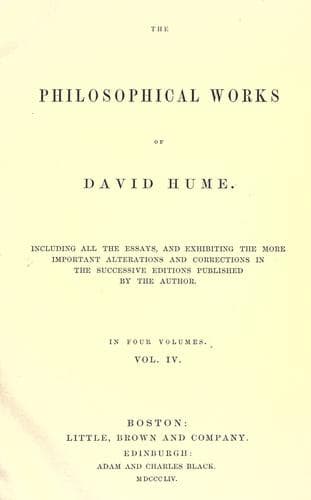
Philosophical Works, v. 1 (of 4): Including All the Essays, and Exhibiting the More Important Alterations and Corrections in the Successive Editions Published by the AuthorHume, David
PhilosophyPhilosophy
Philosophical Works, v. 1 (of 4): Including All the Essays, and Exhibiting the More Important Alterations and Corrections in the Successive Editions Published by the Author
Hume, David
Knowledge, Theory of; Philosophy, English -- 18th century
I cannot be precise as to the time of my writing the King
of Prussia's letter, but I do assure you, with the utmost
truth, that it was several days before you left Paris,
and before Rousseau's arrival there, of which I can give
you a strong proof; for I not only suppressed the letter
while you staid there, out of delicacy to you, but it was
the reason why, out of delicacy to myself, I did not go to
see him, as you often proposed to me; thinking it wrong to
go and make a cordial visit to a man, with a letter in my
pocket to laugh at him. You are at full liberty, dear Sir,
to make use of what I say in your justification, either
to Rousseau or any body else. I should be very sorry to
have you blamed on my account: I have a hearty contempt of
Rousseau, and am perfectly indifferent what any body thinks
of the matter. If there is any fault, which I am far from
thinking, let it lie on me. No parts can hinder my laughing
at their possessor, if he is a mountebank. If he has a bad
and most ungrateful heart, as Rousseau has shown in your
case, into the bargain, he will have my scorn likewise, as
he will of all good and sensible men. You may trust your
sentence to such, who are as respectable judges as any that
have pored over ten thousand more volumes.
Yours most sincerely,
H. W.
Thus I have given a narrative, as concise as possible, of this
extraordinary affair, which I am told has very much attracted the
attention of the public, and which contains more unexpected incidents
than any other in which I was ever engaged. The persons to whom I have
shown the original papers which authenticate the whole, have differed
very much in their opinion, as well of the use I ought to make of them
as of Mr Rousseau's present sentiments and state of mind. Some of them
have maintained that he is altogether insincere in his quarrel with
me, and his opinion of my guilt, and that the whole proceeds from that
excessive pride which forms the basis of his character, and which
leads him both to seek the eclat of refusing the King of England's
bounty, and to shake off the intolerable burthen of an obligation to
me, by every sacrifice of honour, truth, and friendship, as well as of
interest. They found their sentiments on the absurdity of that first
supposition on which he grounds his anger, viz. that Mr Walpole's
letter, which he knew had been every where dispersed both in Paris
and London, was given to the press by me; and as this supposition is
contrary to common sense on the one hand, and not supported even by the
pretence of the slightest probability on the other, they conclude, that
it never had any weight even with the person himself who lays hold of
it. They confirm their sentiments by the number of fictions and lies
which he employs to justify his anger; fictions with regard to points
in which it is impossible for him to be mistaken.
Public-domain text, read in full here on John Shaqi.
Reviews
Reviews
No reviews yet
Be the first to share your thoughts on this work.
Elsewhere in the archive
Join the Discussion
Join the discussion
Sign in to leave a comment or review.
Sign InorCreate an account