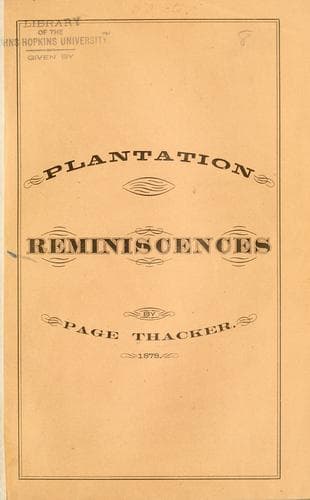
Plantation life; Virginia -- Social life and customs
About this time we had a visit from two old friends of our family--a
distinguished Southern Senator and the Secretary of War--both
accustomed to swaying multitudes by the power of their eloquence--which
lost none of its force and charm in our little home circle. We listened
with admiration as they discussed the political issues of the day--no
longer a subject uninteresting or unintelligible to us, for every
word was of vital importance. Their theme was, "the best means of
protecting our plantation homes and firesides." Even the smallest
children now comprehended the greatest politicians.
Now came the full flow and tide of Southern eloquence--real,
soul-inspiring eloquence!
Many possessing this gift were in the habit of visiting us at that
time; and all dwelt upon one theme--the secession of Virginia--with
glowing words from hearts full of enthusiasm; all agreeing it was
better for States, as well as individuals, to separate rather than
quarrel or fight.
But there was one--our oldest and best friend--who differed with these
gentlemen; and his eloquence was gentle and effective. Unlike his
friends whose words, earnest and electric, overwhelmed all around, this
gentleman's power was in his composure of manner without vehemence. His
words were well selected without seeming to have been studied; each
sentence was short, but contained a gem, like a solitaire diamond.
For several months this gentleman remained untouched by the fiery
eloquence of his friends--like the Hebrew children in the burning
furnace. Nothing affected him until one day, the President of the
United States demanded by telegraph 50,000 Virginians to join an army
against South Carolina. And then this gentleman felt convinced it was
not the duty of Virginians to join an army against their friends.
About this time we had some very interesting letters from the Hon.
Edward Everett--who had been for several years a friend and agreeable
correspondent--giving us his views on the subject, and very soon after
this all communication between the North and South ceased, except
through the blockade, for four long years.
And then came the long dark days; the days when the sun seemed to shine
no more; when the eyes of wives, mothers and sisters were heavy with
weeping; when men sat up late in the night studying military tactics;
when grief-burdened hearts turned to God in prayer.
The intellectual gladiators who had discoursed eloquently of war around
our fireside, buckled their armor on and went forth to battle.
Public-domain text, read in full here on John Shaqi.
Reviews
Reviews
No reviews yet
Be the first to share your thoughts on this work.
Elsewhere in the archive
Join the Discussion
Join the discussion
Sign in to leave a comment or review.
Sign InorCreate an account