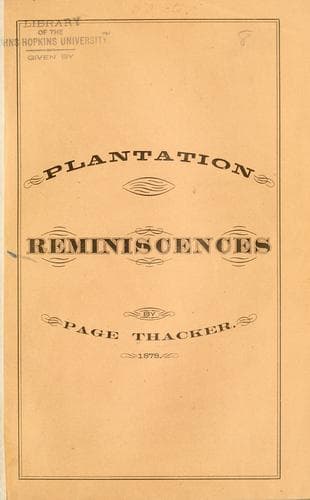
Plantation life; Virginia -- Social life and customs
Among such scenes one of the last pictures photographed on my memory,
was that of a negro boy very ill with typhoid fever in a cabin not
far off, and who became greatly alarmed when a brisk firing commenced
between the contending armies across our house. His first impulse--as
it always had been in trouble--was to fly to his mistress for
protection; and jumping from his bed--his head bandaged with a white
cloth, and looking like one just from the grave--he passed through the
firing as fast as he could, screaming: "O, mistress, take care of me!
Put me in your closet, and hide me from the Yankees!" He fell at the
door exhausted. My mother had him brought in and a bed made for him in
the library. She nursed him carefully, but he died in a day or two from
fright and exhaustion.
Soon after this was the surrender at Appomattox, and negro slavery
ended forever.
All was ruin around us; tobacco factories burned down, sugar and
cotton plantations destroyed. The negroes fled from these desolated
places, crowded together in wretched shanties on the outskirts of
towns and villages, and found themselves, for the first time in their
lives, without enough to eat, and with no class of people particularly
interested about their food, health or comfort. Rations were furnished
them a short time by the United States Government, with promises of
money and land, which were never fulfilled. Impoverished by the war, it
was a relief to us no longer to have the responsibility of supporting
them. This would indeed have been impossible in our starving condition.
Twelve years have passed since they became free, but they have not,
during this time, advanced in intelligence or comfort. Wanting the care
of their owners, they die more frequently; and, it is thought,--by
those who have studied the subject--that abandoned to themselves, they
are returning to the superstitions of their forefathers. A missionary
recently returned from Africa, and witnessing here their religious
rites, says they are the same he saw practiced before the idols in
Africa.
They still have a strange belief in what they call "tricking," and
often the most intelligent, when sick, will say they have been
"tricked," for which they have a regular treatment and "trick doctors"
among themselves. This "tricking" we cannot explain, and only know that
when one negro became angry with another, he would bury in front of his
enemy's cabin door a bottle filled with pieces of snakes, spiders, bits
of tadpole, and other curious substances; and the party expecting to be
"tricked," would hang up an old horse shoe outside of his door to ward
off the "evil spirits."
Public-domain text, read in full here on John Shaqi.
Reviews
Reviews
No reviews yet
Be the first to share your thoughts on this work.
Elsewhere in the archive
Join the Discussion
Join the discussion
Sign in to leave a comment or review.
Sign InorCreate an account