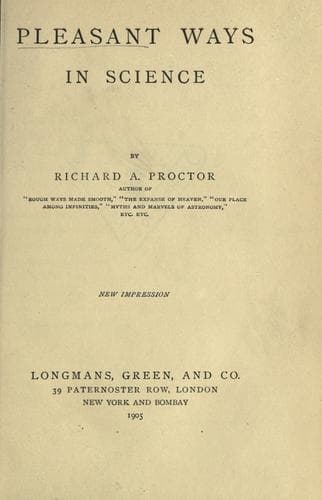
Pleasant Ways in ScienceProctor, Richard A. (Richard Anthony)
Science
Pleasant Ways in Science
Proctor, Richard A. (Richard Anthony)
Science
far more satisfactory determination of the true apparent distance
between the star and the asteroid than can, under any circumstances,
be obtained in the case of Mars and a star. Of course, a much more
exact determination is required to give satisfactory measures of the
asteroid’s real distance from the earth in miles, for a much smaller
error would vitiate the estimate of the asteroid’s distance than would
vitiate to the same degree the estimate of Mars’s distance: for the
apparent displacements of the asteroid as seen either from Northern and
Southern stations, or from stations east and west of the meridian, are
very much less than in the case of Mars, owing to his great proximity.
But, on the whole, there are reasons for believing that the advantage
derived from the nearness of Mars is almost entirely counterbalanced
by the advantage derived from the neatness of the asteroid’s image.
And the number of asteroids, with the consequent power of repeating
such measurements many times for each occasion on which Mars has been
thus observed, seem to make the asteroids—so long regarded as very
unimportant members of the solar system—the bodies from which, after
all, we shall gain our best estimate of the sun’s distance; that is, of
the scale of the solar system.
* * * * *
Since the above pages were written, the results deduced from the
observations made by the British expeditions for observing the transit
of December 9, 1874, have been announced by the Astronomer Royal.
It should be premised that they are not the results deducible from
the entire series of British observations, for many of them can only
be used effectively in combination with observations made by other
nations. For instance, the British observations of the duration of the
transit as seen from Southern stations are only useful when compared
with observations of the duration of the transit as seen from Northern
stations, and no British observations of this kind were taken at
Northern stations, or could be taken at any of the British Northern
stations except one, where chief reliance was placed on photographic
methods. The only British results as yet “worked up” are those which
are of themselves sufficient, theoretically, to indicate the sun’s
distance, viz., those which indicated the epochs of the commencement of
transit as seen from Northern and Southern stations, and those which
indicated the epochs of the end of transit as seen from such stations.
The Northern and Southern epochs of commencement compared together
suffice _of themselves_ to indicate the sun’s distance; so also do the
epochs of the end of transit suffice _of themselves_ for that purpose.
Such observations belong to the Delislean method, which was the subject
of so much controversy for two or three years before the transit took
place. Originally it had been supposed that only observations by that
method were available, and the British plans were formed upon that
assumption.
Public-domain text, read in full here on John Shaqi.
Reviews
Reviews
No reviews yet
Be the first to share your thoughts on this work.
Join the Discussion
Join the discussion
Sign in to leave a comment or review.
Sign InorCreate an account