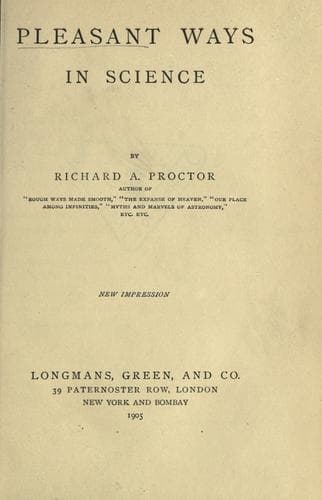
Pleasant Ways in ScienceProctor, Richard A. (Richard Anthony)
Science
Pleasant Ways in Science
Proctor, Richard A. (Richard Anthony)
Science
The obvious significance of this result should be, one would suppose,
that Delisle’s method is not quite so effective as Sir G. Airy
supposed; and the wide discordance between the several results, of
which the result thus deduced is the mean, should prove this, one
would imagine, beyond all possibility of question. The Astronomer
Royal thinks differently, however. In his opinion, the wide difference
between his result and the mean of all the most valued results by other
astronomers, indicates the superiority of Delisle’s method, not its
inadequacy to the purpose for which it has been employed.
Time will shortly decide which of these views is correct; but, for my
own part, I do not hesitate to express my own conviction that the sun’s
distance lies very near the limits indicated by Newcomb, and therefore
is several hundred thousand miles less than the minimum distance
allowed by the recently announced results.
DRIFTING LIGHT-WAVES.
The method of measuring the motion of very swiftly travelling bodies
by noting changes in the light-waves which reach us from them—one
of the most remarkable methods of observation ever yet devised by
man—has recently been placed upon its trial, so to speak; with results
exceedingly satisfactory to the students of science who had accepted
the facts established by it. The method will not be unfamiliar to many
of my readers. The principle involved was first noted by M. Doppler,
but not in a form which promised any useful results. The method
actually applied appears to have occurred simultaneously to several
persons, as well theorists as observers. Thus Secchi claimed in March,
1868, to have applied it though unsuccessfully; Huggins in April, 1868,
described his successful use of the method. I myself, wholly unaware
that either of these observers was endeavouring to measure celestial
motions by its means, described the method, in words which I shall
presently quote, in the number of _Fraser’s Magazine_ for January,
1868, two months before the earliest enunciation of its nature by the
physicists just named.
It will be well briefly to describe the principle of this interesting
method, before considering the attack to which it has been recently
subjected, and its triumphant acquittal from defects charged against
it. This brief description will not only be useful to those readers who
chance not to be acquainted with the method, but may serve to remove
objections which suggest themselves, I notice, to many who have had
the principle of the method imperfectly explained to them.
Public-domain text, read in full here on John Shaqi.
Reviews
Reviews
No reviews yet
Be the first to share your thoughts on this work.
Join the Discussion
Join the discussion
Sign in to leave a comment or review.
Sign InorCreate an account