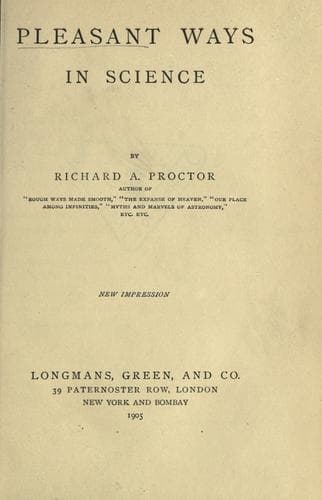
Pleasant Ways in ScienceProctor, Richard A. (Richard Anthony)
Science
Pleasant Ways in Science
Proctor, Richard A. (Richard Anthony)
Science
However, the apparent variation of sound produced by rapid approach or
recession has been tested by exact experiments. On a railway uniting
Utrecht and Maarsen “were placed,” the late Professor Nichol wrote,
“at intervals of something upwards of a thousand yards, three groups
of musicians, who remained motionless during the requisite period.
Another musician on the railway sounded at intervals one uniform note;
and its effects on the ears of the stationary musicians have been
fully published. From these, certainly—from the recorded changes
between grave and the more acute, and _vice versâ_,—confirming, even
_numerically_, what the relative velocities might have enabled one to
predict, it appears justifiable to conclude that the general theory is
correct; and that the note of any sound may be greatly modified, if
not wholly changed, by the velocity of the individual hearing it,” or,
he should have added, by the velocity of the source of sound: perhaps
more correct than either, is the statement that the note may be altered
by the approach or recession of the source of sound, whether that be
caused by the motion of the sounding body, or of the hearer himself, or
of both.
It is difficult, indeed, to understand how doubt can exist in the
mind of any one competent to form an opinion on the matter, though,
as we shall presently see, some students of science and one or two
mathematicians have raised doubts as to the validity of the reasoning
by which it is shown that a change should occur. That the reasoning is
sound cannot, in reality, be questioned, and after careful examination
of the arguments urged against it by one or two mathematicians, I
can form no other opinion than that these arguments amount really
but to an expression of inability to understand the matter. This
may seem astonishing, but is explained when we remember that some
mathematicians, by devoting their attention too particularly to special
departments, lose, to a surprising degree, the power of dealing with
subjects (even mathematical ones) outside their department. Apart
from the soundness of the reasoning, the facts are unmistakably in
accordance with the conclusion to which the reasoning points. Yet some
few still entertain doubts, a circumstance which may prove a source of
consolation to any who find themselves unable to follow the reasoning
on which the effects of approach and recession on wave-lengths depend.
Let such remember, however, that experiment in the case of the aerial
waves producing sound, accords perfectly with theory, and that the
waves which produce light are perfectly analogous (so far as this
particular point is concerned) with the waves producing sound.
Public-domain text, read in full here on John Shaqi.
Reviews
Reviews
No reviews yet
Be the first to share your thoughts on this work.
Elsewhere in the archive
Join the Discussion
Join the discussion
Sign in to leave a comment or review.
Sign InorCreate an account