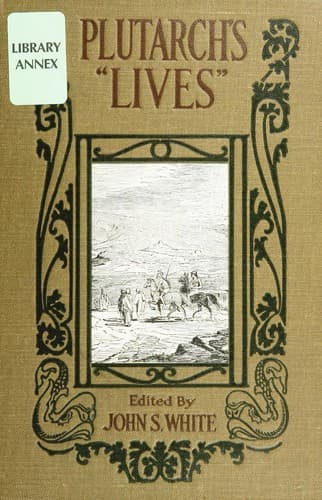
Plutarch: Lives of the noble Grecians and RomansPlutarch
PhilosophyPhilosophy
Plutarch: Lives of the noble Grecians and Romans
Plutarch
Greece -- Biography -- Early works to 1800; Rome -- Biography -- Early works to 1800
There is so much uncertainty in the accounts which historians have left
us of Lycurgus, the lawgiver of Sparta, that scarcely anything is
asserted by one of them which is not called into question or
contradicted by the rest. Their sentiments are quite different as to
the family he came of, the voyages he undertook, the place and manner of
his death, but most of all when they speak of the laws he made and the
commonwealth which he founded. They cannot, by any means, be brought to
an agreement as to the very age in which he lived; for some of them say
that he flourished in the time of Iphitus, and that they two jointly
contrived the ordinance for the cessation of arms during the solemnity
of the Olympic games. Of this opinion was Aristotle; and for
confirmation of it, he alleges an inscription upon one of the copper
quoits used in those sports, upon which the name of Lycurgus continued
uneffaced to his time. But Eratosthenes and Apollodorus and other
chronologers, computing the time by the successions of the Spartan
kings, pretend to demonstrate that he was much more ancient than the
institution of the Olympic games. Timaeus conjectures that there were
two of this name, and in diverse times, but that the one of them being
much more famous than the other, men gave to him the glory of the
exploits of both; the elder of the two, according to him, was not long
after Homer; and some are so particular as to say that he had seen him.
But that he was of great antiquity may be gathered from a passage in
Xenophon, where he makes him contemporary with the Heraclidae. By
descent, indeed, the very last kings of Sparta were Heraclidae too; but
he seems in that place to speak of the first and more immediate
successors of Hercules. But notwithstanding this confusion and
obscurity, we shall endeavor to compose the history of his life,
adhering to those statements which are least contradicted, and depending
upon those authors who are most worthy of credit.
The poet Simonides will have it that Lycurgus was the son of Prytanis,
and not of Eunomus; but in this opinion he is singular, for all the rest
deduce the genealogy of them both as follows:--
Aristodemus
Patrocles
Sous
Eurypon
Eunomus
------------------------------------------
Polydectes by his first wife Lycurgus by Dionassa his second.
Public-domain text, read in full here on John Shaqi.
Reviews
Reviews
No reviews yet
Be the first to share your thoughts on this work.
Elsewhere in the archive
Join the Discussion
Join the discussion
Sign in to leave a comment or review.
Sign InorCreate an account