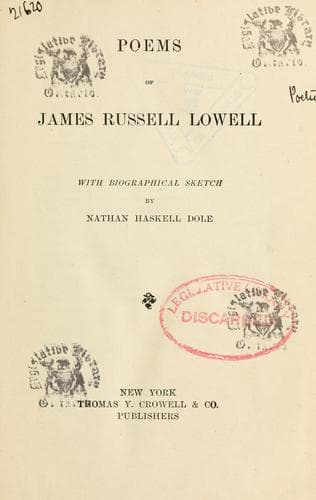
Poems of James Russell Lowell: With biographical sketch by Nathan Haskell DoleLowell, James Russell
General
Poems of James Russell Lowell: With biographical sketch by Nathan Haskell Dole
Lowell, James Russell
American poetry
Light of mine eyes! with thy so trusting look,
And thy sweet smile of charity and love,
That from a treasure well uplaid above,
And from a hope in Christ its blessing took;
Light of my heart! which, when it could not brook
The coldness of another's sympathy,
Finds ever a deep peace and stay in thee,
Warm as the sunshine of a mossy nook;
Light of my soul! who, by thy saintliness
And faith that acts itself in daily life,
Canst raise me above weakness, and canst bless
The hardest thraldom of my earthly strife--
I dare not say how much thou art to me
Even to myself--and O, far less to thee!
XXIII.
Silent as one who treads on new-fallen snow,
Love came upon me ere I was aware;
Not light of heart, for there was troublous care
Upon his eyelids, drooping them full low,
As with sad memory of a healèd woe;
The cold rain shivered in his golden hair,
As if an outcast lot had been his share,
And he seemed doubtful whither he should go:
Then he fell on my neck, and, in my breast
Hiding his face, awhile sobbed bitterly,
As half in grief to be so long distrest,
And half in joy at his security--
At last, uplooking from his place of rest,
His eyes shone blessedness and hope on me.
XXIV.
A gentleness that grows of steady faith;
A joy that sheds its sunshine everywhere;
A humble strength and readiness to bear
Those burthens which strict duty ever lay'th
Upon our souls;--which unto sorrow saith,
"Here is no soil for thee to strike thy roots,
Here only grow those sweet and precious fruits;
Which ripen for the soul that well obey'th;
A patience which the world can neither give
Nor take away; a courage strong and high,
That dares in simple usefulness to live,
And without one sad look behind to die
When that day comes;--these tell me that our love
Is building for itself a home above."
XXV.
When the glad soul is full to overflow,
Unto the tongue all power it denies,
And only trusts its secret to the eyes;
For, by an inborn wisdom, it doth know
There is no other eloquence but so;
And, when the tongue's weak utterance doth suffice,
Prisoned within the body's cell it lies,
Remembering in tears its exiled woe:
That word which all mankind so long to hear,
Which bears the spirit back to whence it came,
Maketh this sullen clay as crystal clear,
And will not be enclouded in a name;
It is a truth which we can feel and see,
But is as boundless as Eternity.
XXVI.
TO THE EVENING-STAR.
Public-domain text, read in full here on John Shaqi.
Reviews
Reviews
No reviews yet
Be the first to share your thoughts on this work.
Join the Discussion
Join the discussion
Sign in to leave a comment or review.
Sign InorCreate an account