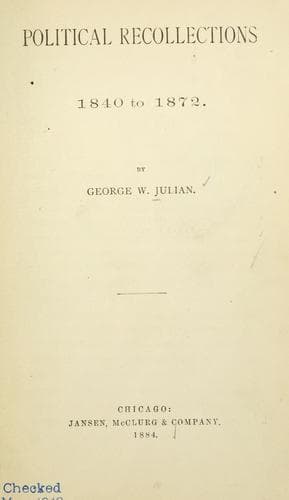
Political Recollections: 1840 to 1872Julian, George Washington
History
Political Recollections: 1840 to 1872
Julian, George Washington
Republican Party (U.S. : 1854- ) -- History; United States -- Politics and government
The dreadful heat of the summer months, and the monotonous "ding-
dong" of the debate on the Compromise measures, made life dreary
enough. The "rump-session," as it was then called, became more
and more dismal as it dragged its slow length into the fall months.
Members grew pale and thin, and sighed for their homes; but the
Congressional mill had to be kept running till the grists of the
slave-power could be got fully ready for the hopper, and ground in
their regular order. Mr. Clay's Omnibus Bill having gone to pieces,
the "five gaping wounds" of the country, about which he had talked
so eloquently, called for treatment in detail; and by far the most
threatening of these was the dispute between Texas and New Mexico.
The remedy was the Texas Boundary Bill, which surrendered a large
belt of country to Texas and slavery, and gave her ten million
dollars besides. It was vehemently opposed in the House, and its
fate seemed to hang in doubt up to the final vote upon it; but
its passage was really assured from the beginning by the corrupt
appliances of its friends. Texas bonds, which were then worth ten
cents on the dollar, would be lifted nearly to par by this measure,
and its success was undoubtedly secured by the bribery of members.
The territorial question was disposed of by the legislative covenant
that new States might be admitted from our Mexican acquisitions,
either with or without slavery, as their people might determine.
This was not only an open abandonment of the Wilmot proviso, but
a legislative condemnation of the Missouri compromise line, as a
violation of the principle of "popular sovereignty," and was sure
to breed the mischiefs which followed four years later. But of
the several compromise or "healing measures" of this session, the
Fugitive Slave Bill was by far the most atrocious. It made the
_ex parte_ interested oath of the slave-hunter final and conclusive
evidence of the fact of escape, and of the identity of the party
pursued, while the simplest duties of humanity were punished as
felonies by fine and imprisonment. The method of its enactment
perfectly accorded with its character. It was reached on the
Speaker's table on September 12th, and on motion of Mr. Thompson,
of Pennsylvania, who served as the parliamentary hangman of his
employers, the previous question was seconded on its passage; and
thus, without reference to any committee, without even being printed,
and with no opportunity whatever for debate, it became a law. It
is needless to say that these pretended measures of final adjustment
paved the way for the repeal of the Missouri restriction, the bloody
raid into Kansas, the Dred Scott decision, and the final chapter
of the Civil War; while they completely vindicated the little party
of Independents in this Congress in standing aloof from the Whig
and Democratic organizations, and warning the country against
further submission to their rule. One hundred guns were fired in
Public-domain text, read in full here on John Shaqi.
Reviews
Reviews
No reviews yet
Be the first to share your thoughts on this work.
Join the Discussion
Join the discussion
Sign in to leave a comment or review.
Sign InorCreate an account