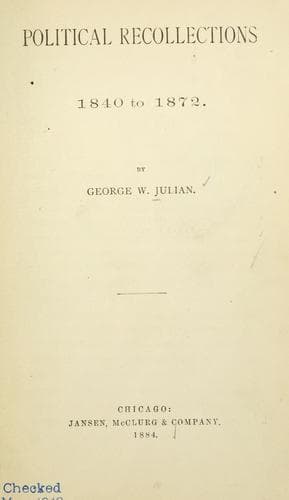
Political Recollections: 1840 to 1872Julian, George Washington
History
Political Recollections: 1840 to 1872
Julian, George Washington
Republican Party (U.S. : 1854- ) -- History; United States -- Politics and government
During this session some laws were passed having no connection with
the slavery question, which were pregnant with very great mischief,
and have only yielded up their meaning as they have been practically
applied and extended. The act of September 28th, granting land
bounties to the soldiers of the Mexican war, opened the way for
the monopoly of many millions of acres of the public domain by
sharks and speculators, while proving a wretched mockery of the
just claims of the men in whose name it was urged. The Swamp Land
Act of the same date, owing to its loose and unguarded provisions
and shameful mal-administration, has been still more fruitful of
wide-spread spoilation and plunder. The act of September 20th,
granting alternate sections of land in aid of the Illinois Central
Railway, inaugurated our famous land-grant policy, which, becoming
more and more reckless and improvident in its exactions, and
cunningly combining the power of great corporations with vast
monopolies of the public domain, has signally eclipsed all other
schemes of commercial feudalism, and left to coming generations a
problem involving the very life of our popular institutions. The
fruits of this legislation were not foreseen at the time, but the
legislation itself fitly belongs to the extraordinary work of this
Congress.
The events of this session formed a new band of union among anti-
slavery men everywhere, and naturally strengthened the wish I had
long cherished to meet some of the famous people with whose names
I had been most familiar. Accordingly, I paid a visit to James
and Lucretia Mott in Philadelphia, which I greatly enjoyed, meeting
there Dr. Elder, J. Miller McKim, Dr. Furness, and other well known
friends of freedom. Oddly enough, I was invited to dine with Judge
Kane, then conspicuous through his remarkable rulings in fugitive
slave cases, and I found his manners and hospitality as charming
as his opinions about slavery were detestable. From Philadelphia
I went to Boston, and attended the Free Soil State Convention which
met there early in October, 1850, where Sumner and Burlingame were
the principal speakers. The latter was extremely boyish in
appearance, but was counted a marvel in native eloquence. Mr.
Sumner was then comparatively a young man, apparently somewhat
fastidious, with a winning face, commanding figure, and a voice
singularly musical. At this time he was only famous through his
orations, and I think knew relatively little of American life and
society outside of Boston and his books. He told me he had recently
been lecturing at several points out of the city, and had been
delighted to find the people so intelligent and so capable of
understanding him. He seemed much surprised when I told him how
many admirers he had in Indiana, and I found that others shared
his unflattering impressions respecting the general intelligence
of the West. At this convention I met Dr. Palfrey, then actively
Public-domain text, read in full here on John Shaqi.
Reviews
Reviews
No reviews yet
Be the first to share your thoughts on this work.
Join the Discussion
Join the discussion
Sign in to leave a comment or review.
Sign InorCreate an account