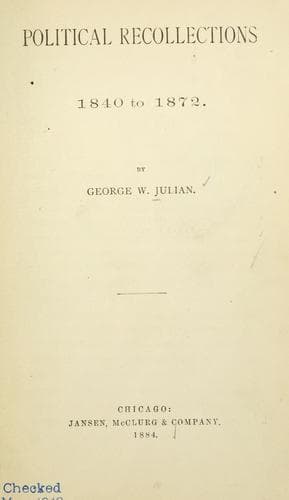
Political Recollections: 1840 to 1872Julian, George Washington
History
Political Recollections: 1840 to 1872
Julian, George Washington
Republican Party (U.S. : 1854- ) -- History; United States -- Politics and government
"south side" theology, already referred to, called forth replies
from various writers, and contributed largely to the general ferment
which the friends of the Compromise measures were so anxious to
tranquilize. Indeed, while the champions of slavery were exerting
themselves as never before to stifle the anti-slavery spirit of
the free States, the Abolitionists were delighted with the tokens
of progress which everywhere saluted their vision and animated them
with new courage and hope.
It was early in the first session of this Congress that several
members of the House introduced bills providing homesteads of one
hundred and sixty acres each to actual landless settlers, without
cost, on prescribed conditions of occupancy and improvement. The
first of these bills in the order of time was that of Andrew Johnson,
which was referred to the Committee on Agriculture, and subsequently
reported favorably, and debated at different times. Similar
propositions were offered in the Senate by Mr. Webster, and by
Senator Walker, of Wisconsin. The fact is also worthy of note,
that Horace Greeley, during his short term of service in the previous
Congress, had offered a bill giving landless men the right to pre-
empt one hundred and sixty acres for seven years, and, on condition
of occupancy and improvement, the "right of unlimited occupancy"
to forty acres of the same, without price, by a single man, or
eighty acres by the married head of a family. But the legislative
initiation of the Homestead law, substantially as we now have it,
belongs to the House of Representatives of the Thirty-first Congress,
and its policy was borrowed from the Free Soil platform of 1848
and the Land Reformers of New York. This measure completely reversed
the early policy of the Government, when settlers on the public
lands were dealt with as trespassers, while its triumph, years
afterward, marked an epoch in our legislation, and has done more
to make the American name honored and loved at home and abroad than
any single enactment since the year 1789. Having earnestly espoused
this policy years before, I sought the acquaintance of Mr. Johnson
for the purpose of co-operating with him in urging it, and found
him its sincere friend. Although loyal to his party, he seemed to
have little sympathy with the extreme men among its leaders, and
no unfriendliness to me on account of my decided anti-slavery
opinions. When my homestead speech was ready for delivery, although
the slave-holders hated its doctrines as heartily as they hated
"abolitionism" itself, and it was through his friendly tactics that
I finally obtained the floor, in opposition to the earnest wish
and determined purpose of Speaker Cobb.
Public-domain text, read in full here on John Shaqi.
Reviews
Reviews
No reviews yet
Be the first to share your thoughts on this work.
Join the Discussion
Join the discussion
Sign in to leave a comment or review.
Sign InorCreate an account