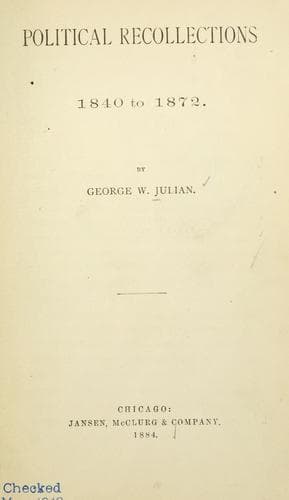
Political Recollections: 1840 to 1872Julian, George Washington
History
Political Recollections: 1840 to 1872
Julian, George Washington
Republican Party (U.S. : 1854- ) -- History; United States -- Politics and government
Some of the finest of Mr. Seward's speeches were delivered during
the first session of this Congress, but in the same husky voice
which marked his later efforts. Decidedly the finest looking man
in the Senate was General Shields, of Illinois, then in his prime,
and crowned with the laurels he had won in the Mexican War. The
appearance of Mr. Douglas, familiarly known as the "little giant,"
was in striking contrast with that of his colleague. He cared
nothing about dignity and refinement, and had a slovenly and
"unwashed" appearance. The towering and erect form of General
Houston always commanded attention in the Senate, and he added to
his attractiveness by wearing an old-fashioned knit cap, and always
devoting a portion of his time to whittling a pine board. The most
fascinating member of the Senate was Soule, of Louisiana. There
was a tropical charm about his oratory, which was heightened by
his foreign accent and his singularly striking presence and
physiognomy. Winthrop was the most accomplished gentleman in the
House. Edward D. Baker, since so famous, was a member from Illinois,
but made no mark. Stephens, of Georgia, looked like a corpse, but
his clear and ringing voice always commanded attention, and his
words went directly to the mark. Toombs was recognized as a leader
of Southern opinion, but disfigured his speeches by his swagger
and defiance. Among the notable men from the Northern States,
Hannibal Hamlin, lately retired from public life, was in the Senate.
He was then a young man, erect, fine looking, a thorough Democrat,
but not the tool of slavery. Thaddeus Stevens was in the House,
and just at the beginning of his remarkable congressional life;
but the slave power, then in full sweep of its despotism, took good
care to keep him in the background in the organization of the
committees. He made several speeches, in which he displayed his
rare powers of invective, irony, and sarcasm, in dealing with the
Southern leaders; and no one who listened to his speech of Feb.
20, 1850, could ever forget his withering reply to Mr. Mead, of
Virginia, who had argued against the prohibition of slavery in the
Territories because it would conflict with the interests of Virginia
as a breeder of slaves. I quote the following:
Public-domain text, read in full here on John Shaqi.
Reviews
Reviews
No reviews yet
Be the first to share your thoughts on this work.
Elsewhere in the archive
Join the Discussion
Join the discussion
Sign in to leave a comment or review.
Sign InorCreate an account