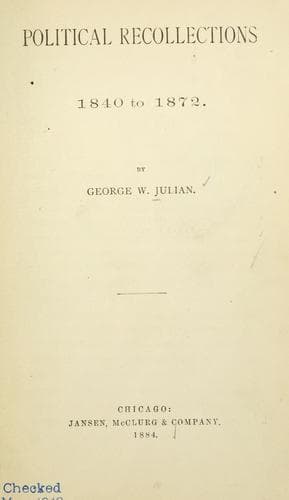
Political Recollections: 1840 to 1872Julian, George Washington
History
Political Recollections: 1840 to 1872
Julian, George Washington
Republican Party (U.S. : 1854- ) -- History; United States -- Politics and government
The Thirty-first Congress was not alone remarkable for the great
questions it confronted and its shameless recreancy to humanity
and justice; it was equally remarkable for its able and eminent
men. In the Senate, the great triumvirate of Webster, Clay, and
Calhoun, appeared in public life for the last time. With them were
associated Benton, Cass, Douglas, Seward, Chase, Bell, Berrien,
Soule, Davis of Mississippi, Dayton, Hale, Ewing, Corwin, Hamlin,
Butler, Houston, and Mason. In the House were Thaddeus Stevens,
Winthrop, Ashmun, Allen, Cobb of Georgia, McDowell, Giddings,
Preston King, Horace Mann, Marshall, Orr, Schenck, Stanley, Toombs,
Alexander H. Stephens, and Vinton. If mere talent could have
supplemented the lack of conscience, the slave power might have
been overborne in 1850, and the current of American history turned
into the channels of liberty and peace. But the better days of
the Republic, when high integrity and unselfish devotion to the
country inspired our statesmen, were past, and we had entered upon
the era of mean ambitions and huckstering politics. "The bulk of
the nation," as Harriet Martineau said, a little later, "was below
its institutions," and our fathers "had laid down a loftier program
than their successors were able to fulfill." It was not strange,
therefore, that the little band of Free Soilers in this Congress
encountered popular obloquy and social outlawry at the Capital.
Their position was offensive, because it rebuked the ruling influences
of the times, and summoned the real manhood of the country to its
rescue. They were treated as pestilent fanatics because they
bravely held up the ideal of the Republic, and sought to make it
real. But they pressed forward along the path of their aspirations.
They found a solace for their social ostracism in delightful
gatherings which assembled weekly at the residence of Dr. Bailey,
where they met philanthropists, reformers, and literary notables.
They had the courage of their opinions, and the genuine satisfaction
which accompanies manliness of character; and they lived to see
their principles vindicated, and the political and social tables
turned upon the men who had honored them by their scorn and contempt.
The anti-slavery revolt of 1848, which they represented, saved
Oregon from slavery, made California a free State, and launched
the policy of free homes on the public domain which finally prevailed
in 1862; and it was the prophecy and parent of the larger movement
which rallied under Fremont in 1856, elected Lincoln in 1860, and
played its grand part in saving the nation from destruction by the
armed insurgents whom it had vanquished at the ballot-box. This
will be the sure award of history; but history will find another
parentage for the party despotism and political corruption which
have since disgraced the administration of the Government.
Public-domain text, read in full here on John Shaqi.
Reviews
Reviews
No reviews yet
Be the first to share your thoughts on this work.
Elsewhere in the archive
Join the Discussion
Join the discussion
Sign in to leave a comment or review.
Sign InorCreate an account