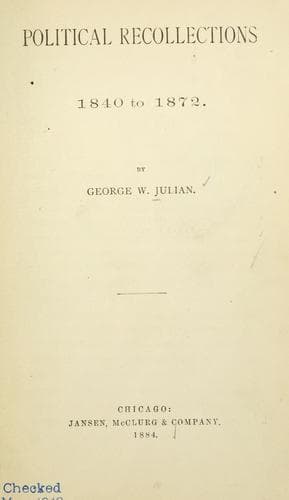
Political Recollections: 1840 to 1872Julian, George Washington
History
Political Recollections: 1840 to 1872
Julian, George Washington
Republican Party (U.S. : 1854- ) -- History; United States -- Politics and government
In no section of the non-slaveholding States was this reaction more
strikingly felt than in the West, and especially in Illinois and
Indiana. These States were outlying provinces of the empire of
slavery. Their black codes and large Southern population bore
witness to their perfect loyalty to slave-holding traditions.
Indiana, while a Territory, had repeatedly sought the introduction
of slavery into her borders. Her black laws had disfigured her
legislation from the beginning, and in 1850 were made still blacker
by her new Constitution, the 13th article of which, forbidding
negroes from coming into the State and white men from encouraging
them to remain, was submitted to the people separately, and ratified
by a popular majority of nearly ninety thousand votes. Ten years
before, in the Harrison campaign, Mr. Bigger, the Whig candidate
for Governor, made himself very popular by proving that Van Buren
had favored negro suffrage in New York. In 1842, four of the
Indiana delegation in Congress--namely, Lane, Wallace, Thompson,
and Kennedy--voted for the censure of Mr. Giddings, which Mr. Clay
indignantly denounced at the time, and two only--namely, White and
Cravens--voted in the negative. Although the execution of the
Fugitive Slave Act of 1793 was a matter of Federal cognizance
exclusively, yet the State code made the harboring of a fugitive
an offense against its peace and dignity, punishable by fine and
imprisonment. The colored people were denied any share in the
school fund, but were taxed for its support; and under the law
forbidding them to testify in cases where white men were parties,
they were at the mercy of any white villain who might take the
precaution of perpetrate an outrage upon them in the absence of
white witnesses. Of course, the organization of an anti-slavery
party strong enough to rule such States as these, was to be the
work of time, toil, and patience. It was only possible to lay the
foundation, and build as the material could be commanded; but the
Free Soilers, whether in the east or in the West, were undismayed
by the crisis, and fully resolved upon keeping up the fight. In
compliance with the wishes of my anti-slavery friends, and by way
of doing my part in the work, I decided to stand for a re-election
from the Fourth Indiana District in the spring of 1851. The Wilmot
proviso Democrats who had been chosen with me two years before on
the strength of their Free Soil pledges, including such men as
Joseph E. McDonald and Graham N. Fitch, now stood squarely on the
Compromise measures.
Public-domain text, read in full here on John Shaqi.
Reviews
Reviews
No reviews yet
Be the first to share your thoughts on this work.
Elsewhere in the archive
Join the Discussion
Join the discussion
Sign in to leave a comment or review.
Sign InorCreate an account