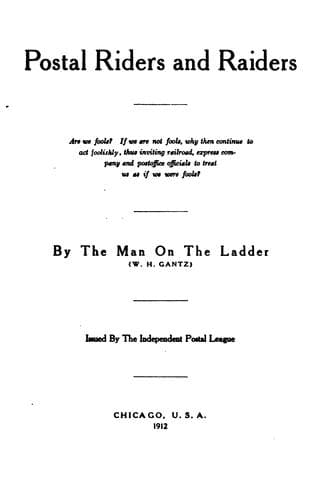
Postal service -- United States -- Second-class matter
As to the “straight matter” in these departmental reports, one often
finds in it some most excellent suggestions, as is certainly the case
with Mr. Hitchcock’s 1910 production. One also finds a lot of other
suggestions and space-written stuff that would make a totem laugh--that
is, of course, presuming a totem could laugh and had advanced as far as
the third grammar school grade in reading.
And the “literary style” of these official reports; so aerial in
elevation, so officially dignified in “tone,” so profusely profound or
profoundly profuse in elaboration and detail, and often so _trivial_ in
significance or import!
If they were still with us, the “literary” standard of most of these
departmental reports would make Bertha M. Clay hug the rail and E. P. Roe
carry weight. But, of course, one must not look for nor expect literary
exaltedness in a departmental report. It should, however, tell us--_we
people_--a good many things we wish to know, in fact, _ought_ to know.
It should not give us too much talk merely to show us how much--or how
little--some chief or assistant knows. If you get the opportunity, read
the Postmaster General’s 1910 report, and you will find many things in it
that will jar you loose from your expectations, but do not be alarmed at
that. Just keep in mind the fact that you can come as near reciting the
Rubaiyat backwards as can Postmaster General Hitchcock, and that you at
least know Old Mother Hubbard “by heart” as well as he knows it.
The point I am trying to make--to emphasize--is that Mr. Hitchcock’s
1910 report presents much valuable information for you and me. So
you should not allow its follies to scare you off. For instance, the
Postmaster General’s fifty notations of “Improvements in Organization and
Methods.” Why he should stop at a round fifty I do not know. I believe
he could easily have added twenty or thirty more _of kind_. Some of
these “improvements” are most excellent; some of them are so assumedly
conclusive on matters previously--for years--in doubt and controversy as
to touch off the risibles in any man who has made anything like a careful
study of conditions governing the Postoffice Department. For instance,
his “Improvement” numbered 10 reads:
“The successful completion of an _inquiry_ into the cost of handling and
transporting mail of the several classes and of conducting the money
order, registry and special delivery services.”
We can _hope_ that the aforesaid “inquiry” was so carefully and
comprehensively conducted as to entitle it to be classed as “successful”
as Mr. Hitchcock’s statement is assertive. However, just how far we may
prudently indulge such hope is a matter for grave consideration. The
Postmaster General’s Third Assistant, James J. Britt, attempts to tell us
(pp. 328-329, 1910 report), all about it. Mr. Britt will be referred to
later.
Public-domain text, read in full here on John Shaqi.
Reviews
Reviews
No reviews yet
Be the first to share your thoughts on this work.
Elsewhere in the archive
Join the Discussion
Join the discussion
Sign in to leave a comment or review.
Sign InorCreate an account