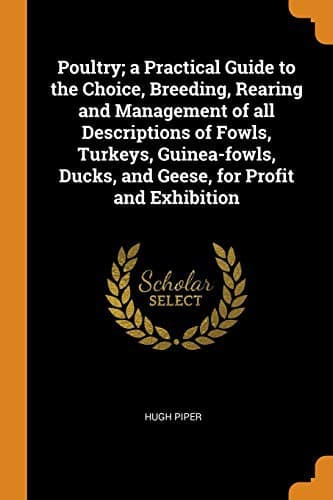
Poultry: A Practical Guide to the Choice, Breeding, Rearing, and Management of all Descriptions of Fowls, Turkeys, Guinea-fowls, Ducks, and Geese, for Profit and Exhibition.Piper, Hugh
Science
Poultry: A Practical Guide to the Choice, Breeding, Rearing, and Management of all Descriptions of Fowls, Turkeys, Guinea-fowls, Ducks, and Geese, for Profit and Exhibition.
Piper, Hugh
Poultry -- Breeding
The best filling for hatching nests is fine dry sand, mould, coal or
wood ashes placed on a cut turf, covering it and lining the sides with a
little well-broken dry grass, moss, bruised straw, lichen, or liverwort
collected from trees, or dry heather, which is the best of all, but
cannot always be had. Hay, though soft at first, soon becomes hard and
matted, and is also said to breed vermin. Straw is good material, but
must be cut into short pieces, for if long straw is used and the hen
should catch her foot in it, and drag it after her when she leaves the
nest, it will disturb, if not break, the eggs. The nests of the sitting
hens in Her Majesty's poultry-yard at Windsor are made of heather,
which offers an excellent medium between the natural damp hedge-nest of
the hen and the dryness of a box filled with straw, and also enables her
to free herself from those insects which are so troublesome to sitting
hens. A thick layer of ashes placed under the straw in cold weather will
keep in the heat of the hen. A little Scotch snuff is a good thing to
keep the nests free from vermin.
Where only a few fowls are kept, and a separate place cannot be found
for the sitting hen, she can be placed on a nest which should be covered
over with a coop, closed in with a little boarding or some other
contrivance for a day or two, to prevent her being disturbed by any
other fowls that have been accustomed to lay there. They will then soon
use another nest. She should be carefully lifted off her nest, by taking
hold of her under the wings, regularly every morning, exercised and fed,
and then shut in, so that she cannot be annoyed.
It is best to allow a hen to keep the nest she has chosen when she shows
an inclination to sit; and if she continues to sit steadily, and has not
a sufficient number of eggs under her, or the eggs you desire her to
hatch, remove her gently at night, replace the eggs with the proper
batch, and place her quietly upon the nest again. Hens are very fond of
choosing their own nests in out of the way places; and where the spot is
not unsafe, or too much exposed to the weather, it is best to let her
keep possession, for it has been noticed that, when she selects her own
nest and manages for herself, she generally brings forth a good and
numerous brood. Mr. Tegetmeier observes that he has "reason to believe,
indeed, that whatever care may be taken in keeping eggs, their vitality
is better preserved when they are allowed to remain in the nest. Perhaps
the periodical visits of the hen, while adding to her store of eggs, has
a stimulating influence. The warmth communicated in the half-hour during
which she occupies the nest may have a tendency to preserve the embryo
in a vigorous state."
Public-domain text, read in full here on John Shaqi.
Reviews
Reviews
No reviews yet
Be the first to share your thoughts on this work.
Join the Discussion
Join the discussion
Sign in to leave a comment or review.
Sign InorCreate an account