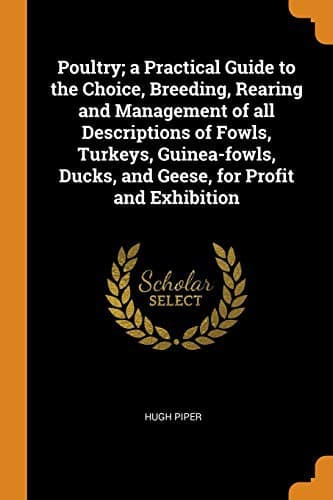
Poultry: A Practical Guide to the Choice, Breeding, Rearing, and Management of all Descriptions of Fowls, Turkeys, Guinea-fowls, Ducks, and Geese, for Profit and Exhibition.Piper, Hugh
Science
Poultry: A Practical Guide to the Choice, Breeding, Rearing, and Management of all Descriptions of Fowls, Turkeys, Guinea-fowls, Ducks, and Geese, for Profit and Exhibition.
Piper, Hugh
Poultry -- Breeding
It is a good plan, before giving an untried hen choice eggs, to let her
sit upon a few chalk or stale eggs for a few days, and if she continue
to sit with constancy, then to give her the batch for hatching. When
choice can be made out of several broody hens for a valuable batch of
eggs, one should be selected with rather short legs, a broad body, large
wings well furnished with feathers, and having the nails and spurs not
too long or sharp. As a rule, hens which are the best layers are the
worst sitters, and those with short legs are good sitters, while
long-legged hens are not. Dorkings are the best sitters of all breeds,
and by high feeding may be induced to sit in October, especially if they
have moulted early, and with great care and attention chickens may be
reared and made fit for table by Christmas. Early in the spring Dorkings
only should be employed as mothers, for they remain much longer with
their chickens than the Cochin-Chinas, but the latter may safely be
entrusted with a brood after April. Cochins are excellent sitters, and,
from the quantity of "fluff" which is peculiar to them, keep the eggs at
a high and regular degree of heat. Their short legs also are
advantageous for sitting. A Cochin hen can always be easily induced to
sit, and eggs of theirs or of Brahma Pootras for sitting, are not wanted
in the coldest weather.
Old hens are more steady sitters than pullets, more fond of their brood,
and not so apt as pullets to leave them too soon. Indeed, pullets were
formerly never allowed to sit before the second year of their laying,
but now many eminent authorities think it best to let them sit when they
show a strong desire to do so, considering that the prejudice against
them upon this point is unfounded, and that young hens sit as well as
older fowls. Pullets hatched early will generally begin to lay in
November or December, if kept warm and well fed, and will sit in January
or February.
Broody hens brought from a distance should be carried in a basket,
covered over with a cloth.
Public-domain text, read in full here on John Shaqi.
Reviews
Reviews
No reviews yet
Be the first to share your thoughts on this work.
Join the Discussion
Join the discussion
Sign in to leave a comment or review.
Sign InorCreate an account