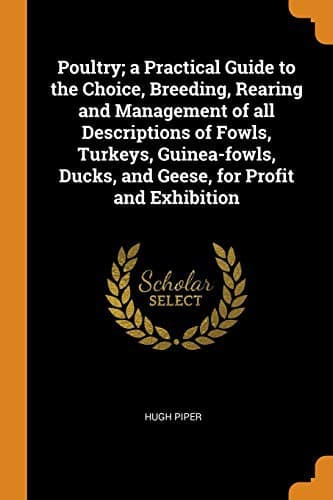
Poultry: A Practical Guide to the Choice, Breeding, Rearing, and Management of all Descriptions of Fowls, Turkeys, Guinea-fowls, Ducks, and Geese, for Profit and Exhibition.Piper, Hugh
Science
Poultry: A Practical Guide to the Choice, Breeding, Rearing, and Management of all Descriptions of Fowls, Turkeys, Guinea-fowls, Ducks, and Geese, for Profit and Exhibition.
Piper, Hugh
Poultry -- Breeding
either by the coldness of the season or delicacy of constitution, they
must be fed highly, and have a daily supply of bread soaked in ale.
Ants' eggs, which are well known as the very best animal diet for young
pheasants, are also excellent for young chickens; and when a nest can be
obtained it should be thrown with its surrounding mould into the run for
them to peck at. Where there is no grass-plot they should have some
grass cut into small pieces, or other vegetable food minced small, until
they are able to peck pieces from the large leaves. Onion tops and leeks
chopped small, cress, lettuce, and cabbage, are much relished by all
young poultry. The French breeders give a few dried nettle seeds
occasionally. Young growing fowls can scarcely have too much food, so
long as they eat it with a good appetite, and do not tread any about, or
otherwise leave it to waste.
Young poultry cannot thrive if overcrowded. They should not be allowed
to roost on the branches of trees or shrubs, or otherwise out of doors,
even in the warmest weather, or they will acquire the habit of sleeping
out, which cannot be easily overcome; not that they would suffer much
from even severe weather, when once accustomed to roosting out of doors,
but from want of warmth the supply of eggs would decrease, and it would,
in many places, be unsafe and, in most, inconvenient.
The sooner chickens can be fattened, of course the greater must be the
profit. They should be put up for fattening as soon as they have quitted
the hen, for they are then generally in good condition, but begin to
lose flesh as their bones develop and become stronger, particularly
those fowls which stand high on the leg.
Fowls are in perfection for eating just before they are fully developed.
By keeping young fowls, especially the cockerels, too long before
fattening them for market or home consumption, they eat up all the
profit that would be made by disposing of them when the pullets have
ceased laying just before their first adult moult, and the cockerels
before their appetites have become large. Fowls intended to be fattened
should be well and abundantly fed from their birth; for if they are
badly fed during their growth they become stunted, the bones do not
attain their full size, and no amount of feeding will afterwards supply
these defects and transform them into fine, large birds. Poultry that
have been constantly fed well from their birth will not only be always
ready for the table, with very little extra attention and feeding, but
their flesh will be superior in juiciness and rich flavour to those
which are fattened up from a poor state. In choosing full-grown fowls
for fattening, the short-legged and early-hatched should be preferred.
Public-domain text, read in full here on John Shaqi.
Reviews
Reviews
No reviews yet
Be the first to share your thoughts on this work.
Elsewhere in the archive
Join the Discussion
Join the discussion
Sign in to leave a comment or review.
Sign InorCreate an account