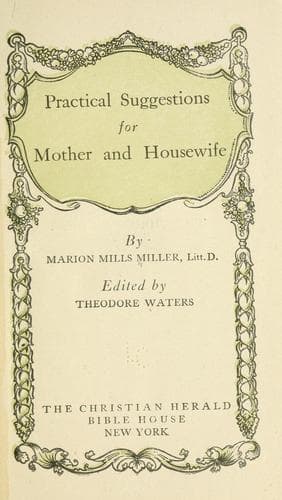
Practical Suggestions for Mother and HousewifeMiller, Marion Mills
Philosophy
Practical Suggestions for Mother and Housewife
Miller, Marion Mills
Home economics
The relative retail prices of the various cuts usually bear a direct
relation to the favor with which they are regarded by the majority of
persons, the juicy tender cuts of good flavor selling for the higher
prices. When porterhouse steak sells for 25 cents a pound, it may be
assumed that in town or village markets round steak would ordinarily
sell for about 15 cents, and chuck ribs, one of the best cuts of the
forequarter, for 10 cents. This makes it appear that the chuck ribs
are less than half as expensive as porterhouse steak and two-thirds as
expensive as the round. But apparent economy is not always real economy,
and in this case the bones in the three cuts should be taken into
account. Of the chuck ribs, more than one-half is bone or other
materials usually classed under the head of "waste" or "refuse."
Of the round, one-twelfth is waste, and of the porterhouse one-eighth.
In buying the chuck, then, the housewife gets, at the prices assumed,
less than one-half pound of food for 10 cents, making the net price
of the edible portion 22 cents a pound; in buying round, she gets
eleven-twelfths of a pound for 15 cents, making the net value about 16-1/2
cents; in buying porterhouse, she gets seven-eighths of a pound for
25 cents, making the net value about 28-1/2 cents a pound. The relative
prices, therefore, of the edible portions are 22, 16-1/2, and 28-1/2
cents; or to put it in a different way, a dollar at the prices assumed
will buy 4-1/2 pounds of solid meat from the cut, known as chuck, 6
pounds of such meat from the round, and only 3-1/2 pounds of such meat
from the porterhouse. To this should be added the fact that because of
the way in which porterhouse is usually cooked no nutriment is obtained
from the bone, while by the long slow process by which the cheaper cuts,
except when they are broiled or fried, are prepared the gelatin, fat,
and flavoring material of the bone are extracted. The bones of meats
that are cooked in water, therefore, are in a sense not all refuse,
for they contain some food which may be secured by proper cookery.
It is true, of course, that the bones of the steaks may be used for soup
making, and that the nourishment may thus be utilized, but this must be
done by a separate process from that of cooking the steak itself.
TEXTURE AND FLAVOR OF MEAT
Public-domain text, read in full here on John Shaqi.
Reviews
Reviews
No reviews yet
Be the first to share your thoughts on this work.
Elsewhere in the archive
Join the Discussion
Join the discussion
Sign in to leave a comment or review.
Sign InorCreate an account