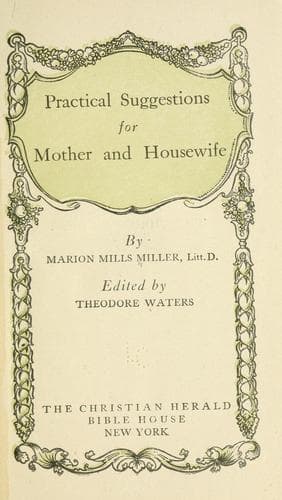
Practical Suggestions for Mother and HousewifeMiller, Marion Mills
Philosophy
Practical Suggestions for Mother and Housewife
Miller, Marion Mills
Home economics
The amount of the extractives which will be brought out into the water
when meat is boiled depends upon the size of the pieces into which the
meat is cut and on the length of time they are soaked in cold water
before being heated. A good way to hinder the escape of the flavoring
matter is to sear the surface of the meat quickly by heating it in fat,
or the same end may be attained by plunging it into boiling water. Such
solubility is taken advantage of in making beef tea at home and in the
manufacture of meat extract, the extracted material being finally
concentrated by evaporating the water.
GENERAL METHODS OF COOKING MEAT
The advantages of variety in the methods of preparing and serving are to
be considered even more seriously in the cooking of the cheaper cuts
than in the cooking of the more expensive ones, and yet even in this
connection it is a mistake to lose sight of the fact that, though there
is a great variety of dishes, the processes involved are few in number.
An experienced teacher of cooking, a woman who has made very valuable
contributions to the art of cookery by showing that most of the numerous
processes outlined and elaborately described in the cook books can be
classified under a very few heads, says that she tries "to reduce the
cooking of meat to its lowest terms and teach only three ways of
cooking. The first is the application of intense heat to keep in the
juices. This is suitable only for portions of clear meat where the
fibers are tender. By the second method the meats are put in cold water
and cooked at a low temperature. This is suitable for bone, gristle,
and the toughest portions of the meat which for this purpose should
be divided into small bits. The third is a combination of these two
processes and consists of searing and then stewing the meat. This is
suitable for halfway cuts, i. e., those that are neither tender nor very
tough." The many varieties of meat dishes are usually only a matter of
flavor and garnish.
In other words, of the three processes the first is the short method;
it aims to keep all the juices within the meat. The second is a very long
method employed for the purpose of getting all or most of the juices
out. The third is a combination of the two not so long as the second and
yet requiring so much time that there is danger of the meat being
rendered tasteless unless certain precautions are taken, such as searing
in hot fat or plunging into boiling water.
Public-domain text, read in full here on John Shaqi.
Reviews
Reviews
No reviews yet
Be the first to share your thoughts on this work.
Elsewhere in the archive
Join the Discussion
Join the discussion
Sign in to leave a comment or review.
Sign InorCreate an account