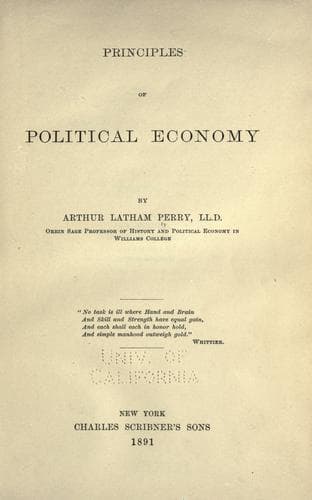
Principles of Political EconomyPerry, Arthur Latham
General
Principles of Political Economy
Perry, Arthur Latham
Economics
Let us catch up another illustration from the science of Botany, to
show how Deduction may strengthen and sharpen an inductive result. The
botanists say, that apple-tree blossoms are always five-petaled,
because blossoms from a large number of apple-trees in various
localities have been observed to have just five petals to the blossom;
so far, they affirm inductively, and indeed securely; but they have
also reached by means of another induction a much broader law of
plant-life, namely, that outside-growers, when they have petaled
flowers at all, always have them five-fold; now apple-trees are
outside-growers; and therefore, deductively also, and conclusively
beyond shadow of question, apple-tree blossoms are five-petaled.
Political Economy is just as open to Deduction as it is to Induction,
and the two continually are reaching each other the hands of
economical reasoning, not always indeed pursuing each a separate and
distinct path to the end, as in the botanical instance just adduced;
because in practice the two processes mingle constantly, and neither
is carried out in full and due form, since premises used by the mind
are often dropped in the statement, and shortened forms of expression
take the place of long-drawn-out formulas. But all good reasoning in
Economics, as in all other sciences, is analyzable into one or other
of these two processes, both based alike on the uniformities of Nature
and the structure of the human mind.
Deduction has not quite the same scope and certainty in Economics as
in the Physical Sciences, because any one _may_ act contrary to the
vastly probable action of many individuals; still, it is a safe and
potent process in economics, since it may descend securely from the
larger masses to the smaller, even though perchance the individual
escape, because of the simplicity and universality and certainty of
the impulses that lead men to exchange. John Bascom gives the reason
well, why both Induction and Deduction have so firm a grasp upon this
science: "_Between one dollar and two dollars a man has no choice, he
must take the greater; between one day and two days of labor he must
take the less; between the present and the future he must take the
present. This is not a sphere of caprice, nor scarcely even of
liberty; the actions themselves present no alternative, and, if an
alternative giving an opportunity for choice does arise, it arises
from some partial or individual impulse, from some one of those
transitory and foreign influences, which, while rippling the surface,
neither belong to nor affect the current of the stream._"
Public-domain text, read in full here on John Shaqi.
Reviews
Reviews
No reviews yet
Be the first to share your thoughts on this work.
Elsewhere in the archive
Join the Discussion
Join the discussion
Sign in to leave a comment or review.
Sign InorCreate an account