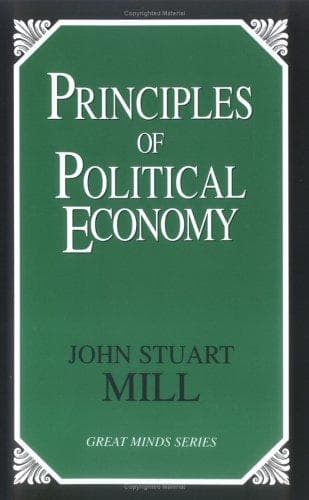
Principles of Political Economy: Abridged with Critical, Bibliographical, and Explanatory Notes, and a Sketch of the History of Political EconomyMill, John Stuart
PhilosophyPhilosophy
Principles of Political Economy: Abridged with Critical, Bibliographical, and Explanatory Notes, and a Sketch of the History of Political Economy
Mill, John Stuart
Economics
what sort, from an unproductive destination to a productive, has had the
effect of causing more food to be appropriated to the consumption of
productive laborers. The distinction, then, between Capital and
Not-capital, does not lie in the kind of commodities, but in the mind of
the capitalist—in his will to employ them for one purpose rather than
another; and all property, however ill adapted in itself for the use of
laborers, is a part of capital, so soon as it, or the value to be received
from it, is set apart for productive reinvestment.
§ 2. More Capital Devoted to Production than Actually Employed in it.
As whatever of the produce of the country is devoted to production is
capital, so, conversely, the whole of the capital of the country is
devoted to production. This second proposition, however, must be taken
with some limitations and explanations. (1) A fund may be seeking for
productive employment, and find none adapted to the inclinations of its
possessor: it then is capital still, but unemployed capital. (2) Or the
stock may consist of unsold goods, not susceptible of direct application
to productive uses, and not, at the moment, marketable: these, until sold,
are in the condition of unemployed capital.
This is not an important distinction. The goods are doubtless
marketable at some price, if offered low enough. If no one wants
them, then, by definition, they are not wealth so long as that
condition exists.
(3) [Or] suppose that the Government lays a tax on the production in one
of its earlier stages, as, for instance, by taxing the material. The
manufacturer has to advance the tax, before commencing the manufacture,
and is therefore under a necessity of having a larger accumulated fund
than is required for, or is actually employed in, the production which he
carries on. He must have a larger capital to maintain the same quantity of
productive labor; or (what is equivalent) with a given capital he
maintains less labor. (4) For another example: a farmer may enter on his
farm at such a time of the year that he may be required to pay one, two,
or even three quarters’ rent before obtaining any return from the produce.
This, therefore, must be paid out of his capital.
(5) Finally, that large portion of the productive capital of a country
which is employed in paying the wages and salaries of laborers, evidently
is not, all of it, strictly and indispensably necessary for production. As
much of it as exceeds the actual necessaries of life and health (an excess
which in the case of skilled laborers is usually considerable) is not
expended in supporting labor, but in remunerating it, and the laborers
could wait for this part of their remuneration until the production is
completed.
Public-domain text, read in full here on John Shaqi.
Reviews
Reviews
No reviews yet
Be the first to share your thoughts on this work.
Join the Discussion
Join the discussion
Sign in to leave a comment or review.
Sign InorCreate an account