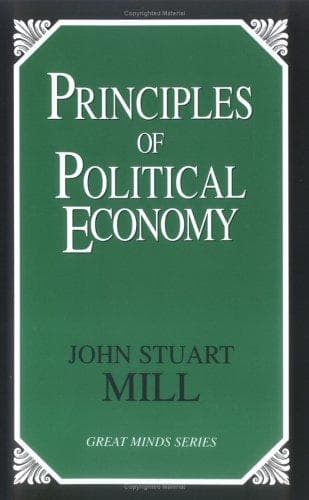
Principles of Political Economy: Abridged with Critical, Bibliographical, and Explanatory Notes, and a Sketch of the History of Political EconomyMill, John Stuart
PhilosophyPhilosophy
Principles of Political Economy: Abridged with Critical, Bibliographical, and Explanatory Notes, and a Sketch of the History of Political Economy
Mill, John Stuart
Economics
(3.) Suppose, however, that C, the borrowing landlord, is a spendthrift,
who burdens his land not to increase his fortune but to squander it,
expending the amount in equipages and entertainments. In a year or two it
is dissipated, and without return. A is as rich as before; he has no
longer his ten thousand pounds, but he has a lien on the land, which he
could still sell for that amount. C, however, is ten thousand pounds
poorer than formerly; and nobody is richer. It may be said that those are
richer who have made profit out of the money while it was being spent. No
doubt if C lost it by gaming, or was cheated of it by his servants, that
is a mere transfer, not a destruction, and those who have gained the
amount may employ it productively. But if C has received the fair value
for his expenditure in articles of subsistence or luxury, which he has
consumed on himself, or by means of his servants or guests, these articles
have ceased to exist, and nothing has been produced to replace them: while
if the same sum had been employed in farming or manufacturing, the
consumption which would have taken place would have been more than
balanced at the end of the year by new products, created by the labor of
those who would in that case have been the consumers. By C’s prodigality,
that which would have been consumed with a return is consumed without
return. C’s tradesmen may have made a profit during the process; but, if
the capital had been expended productively, an equivalent profit would
have been made by builders, fencers, tool-makers, and the tradespeople who
supply the consumption of the laboring-classes; while, at the expiration
of the time (to say nothing of an increase), C would have had the ten
thousand pounds or its value replaced to him, which now he has not. There
is, therefore, on the general result, a difference, to the disadvantage of
the community, of at least ten thousand pounds, being the amount of C’s
unproductive expenditure. To A, the difference is not material, since his
income is secured to him, and while the security is good, and the market
rate of interest the same, he can always sell the mortgage at its original
value. To A, therefore, the lien of ten thousand pounds on C’s estate is
virtually a capital of that amount; but is it so in reference to the
community? It is not. A had a capital of ten thousand pounds, but this has
been extinguished—dissipated and destroyed by C’s prodigality. A now
receives his income, not from the produce of his capital, but from some
other source of income belonging to C, probably from the rent of his land,
that is, from payments made to him by farmers out of the produce of
_their_ capital.
Public-domain text, read in full here on John Shaqi.
Reviews
Reviews
No reviews yet
Be the first to share your thoughts on this work.
Join the Discussion
Join the discussion
Sign in to leave a comment or review.
Sign InorCreate an account