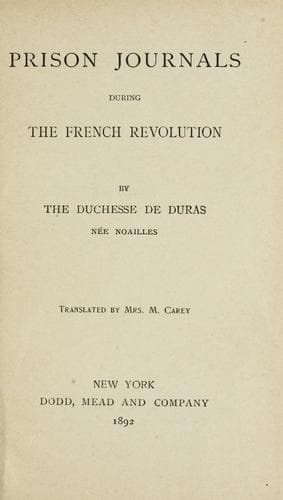
Prison Journals During the French Revolution — John Shaqi
Prison Journals During the French RevolutionDuras, Louise Henriette Charlotte Philippine (de Noailles) de Durfort, duchesse de
History
Prison Journals During the French Revolution
Duras, Louise Henriette Charlotte Philippine (de Noailles) de Durfort, duchesse de
France -- History -- Revolution, 1789-1799 -- Personal narratives
I comforted
myself sometimes with the hope that my parents' advanced age and their
virtues would save them, and that I only would perish; for I saw
clearly from all the refusals I had received that I should be obliged
to renounce entirely the happiness of joining them. This was for me the
greatest possible sorrow, but each day brought others. I could never
have endured my situation with fortitude had I not resigned myself
entirely to the will of God. The charity which we were so frequently
called upon to exercise helped to distract our minds. One day, for
instance, I met a poor woman who arrived overcome with fatigue from her
long, miserable journey, having slept by the way only in infected
prisons. The jailer, in order to force her to go to her apartment,
which was very high up, spoke to her in most abusive language, and even
kicked her, to rouse her from the prostration which overcame her as she
mounted the stairs. I begged this cruel citizen not to treat her as a
beast of burden, but to put her in my charge. I had great trouble to
gain this favour from him, but succeeded with the help of one of my
companions in getting her away from the barbarian. I think she was
Madame de Richelieu.
Madame de Rochechouart, her mother, was a singular example of the well
established fact that prison life cured several very great invalids.
When she was arrested at Courteille she was spitting blood so
constantly that it was thought she would never reach Paris. On reaching
Plessis her health became much better, though she lived in a room where
the plaster was still fresh, without fire, and exposed to every wind. I
believe it was the strict diet forced upon us by the poor food which
produced this happy effect. One ate only what was just necessary to
sustain life. The mind was so agitated that the body felt the effects
of the strain. I remember that one night I was so hungry that I got up
to get some chocolate, wondering that a physical need could distract me
from the sad thoughts which beset me when awake. One day I spoke to
Madame de la Fayette on this subject, saying to her that I could not
conceive how, occupied as we were constantly with thoughts of death,
and having it continually before us, we could provide for the next day
what was needful to preserve our lives. While we were in the refectory
we were informed that a poor woman had thrown herself out of the only
window without a grating in the whole house, and that she was dying in
the courtyard; it was surely despair which had urged her to this act of
folly. I ran to the spot where they had carried her, and found her
crushed, and showing no signs of consciousness. The keeper was beside
himself, fearing lest this accident should compromise him, and never
thought of doing anything for the unfortunate creature. I implored him,
as our surgeon had made his rounds and lived at a great distance, to
send for one of the physicians who were imprisoned in the building used
as a court.
Public-domain text, read in full here on John Shaqi.
Reviews
Reviews
No reviews yet
Be the first to share your thoughts on this work.
Join the Discussion
Join the discussion
Sign in to leave a comment or review.
Sign InorCreate an account