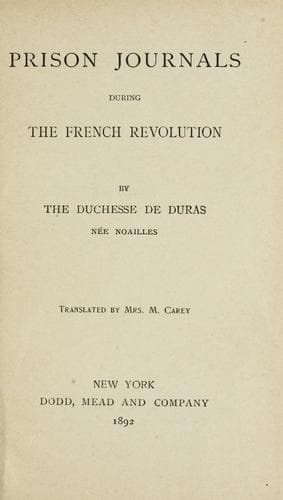
Prison Journals During the French RevolutionDuras, Louise Henriette Charlotte Philippine (de Noailles) de Durfort, duchesse de
History
Prison Journals During the French Revolution
Duras, Louise Henriette Charlotte Philippine (de Noailles) de Durfort, duchesse de
France -- History -- Revolution, 1789-1799 -- Personal narratives
All those composing the convoy from Neuilly, though scarcely settled in
lodgings, came very near being sent in a body to the Conciergerie to
perish the next day. About midnight I heard the sound of carriages,--a
not uncommon thing, as I slept lightly. A melancholy curiosity,
inspired by fear, induced me to rise and see what was going on.
I saw by the light of a number of torches a great many gendarmes and
bailiffs, and at the same moment a frightful noise was heard in our
corridor. Loud voices cried, 'Let all who belong to the convoy from
Neuilly prepare to depart.' I trembled all over, and went out to go and
see my neighbours, who, little accustomed to the rules of the house,
were quite undisturbed, since they had been told that this was only a
removal. I do not remember whether I told them of the fate which
immediately threatened them, so they might prepare for it, or whether I
left them in ignorance of their death-summons. For some time they
remained in suspense; then the jailers came to say that there was a
mistake. We afterward learned that it was by mistake that they had come
that night to the Plessis. The executioners did not let their wagons
remain empty, but went to another prison to fill them. It was necessary
to have a certain number of victims every day, except from our prison,
where the number varied. I have known as many as sixty-four to be sent
from us in one day.
One thing seems almost incredible unless one witnessed it: it is that
constantly one could hear the prisoners playing on different
instruments, and singing in chorus the Republican airs; and again, that
one could see women caring for their dress, and even coquettish, while,
besides the guillotine, they were threatened with death by fire and
water. We heard that we were to be shot as the Lyonnais were, against a
wall which was newly erected in our courtyard and was destined, it was
said, for that purpose. In addition to these rumours, the fire in the
library of the abbey of St. Germain,--which we saw very plainly,--as
well as the explosion of the magazine at Grenelle, gave us a great deal
of anxiety. As far as I myself was concerned, I am sure these two
events disturbed me but little; but I was terribly anxious on account
of those dear to me. The walk in the open air, which was necessary for
our existence, became almost intolerable. One day when I was out, I saw
several persons dismount who came from Angoumois. It was about six
o'clock in the evening; the name of one of them, an old lady named De
Boursac, reminded me of two of the king's equerries who bore the same
name, and I gave her some information concerning them which seemed to
afford her great pleasure. She told me they were her children, and that
she had two others with her. My first conversation was a last farewell,
for she was executed with them the next day. The pretext of
conspiracies began to be fashionable in order to cause the death of a
great many persons of different classes at the same time.
Public-domain text, read in full here on John Shaqi.
Reviews
Reviews
No reviews yet
Be the first to share your thoughts on this work.
Join the Discussion
Join the discussion
Sign in to leave a comment or review.
Sign InorCreate an account