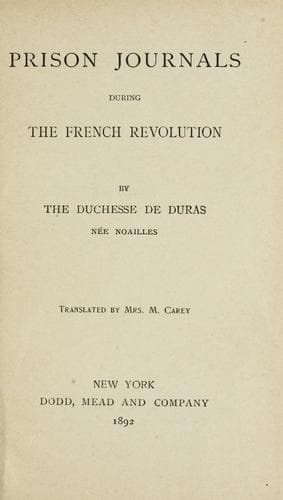
Prison Journals During the French RevolutionDuras, Louise Henriette Charlotte Philippine (de Noailles) de Durfort, duchesse de
History
Prison Journals During the French Revolution
Duras, Louise Henriette Charlotte Philippine (de Noailles) de Durfort, duchesse de
France -- History -- Revolution, 1789-1799 -- Personal narratives
On the 19th of October, 1794, at ten o'clock in the morning, while I
was busy with my morning duties, I heard my door open suddenly. A
little while before I should have been sure that it was the
announcement of my death, and I did not even now think this sudden
interruption brought me good news; but some one, whose name I do not
remember, said to me delightedly, 'You are free!' My heart, so unused
to pleasurable emotions, was slow to entertain the idea. The keeper
entered, confirmed the news, and brought me my _acte de liberté_. I
then thought sadly of how little use it would be to me. Deprived of
every comfort, separated from my son and my parents, from Madame de
Chimay,--the only friend that Heaven had left to me,--without a home,
and in want of the very necessaries of life, I felt irritated by the
congratulations of the jailers and the gendarmes who had formerly
threatened me with the guillotine, and was very much afraid that they
would, according to their usual custom, manifest their feelings by
embracing me; but I fortunately escaped. In this confused condition of
thought and feeling, the memory of my dear son and the thought of what
I could be to him aroused my courage, which had succumbed at this
terrible crisis. It was necessary to pack up my small wardrobe, which
took only a short time. All my effects were put in two bundles. I bade
farewell to Madame de la Fayette, who, with several other persons, was
destined to remain in prison. I felt very grateful for the pleasure
which, despite her unfortunate situation, she showed at seeing me
released from bondage. I engaged a commissioner at the grating, who
helped me with my baggage. We arrived safely at the house of my
mother-in-law, who then lived on the Rue de Bellechasse. She received
me most kindly and tenderly. I found her with my niece; they did not
expect me, and neither did Monsieur Noël, who had on account of his
interest and attachment for me laboured to have me liberated. He came
to see me, and assured me that Madame Drulh (a former governess of
Madame de Mailly) was very anxious to have me stay at her house. I
accepted the kind offer for a few days, though I feared to compromise
her, since there was still great ill-feeling entertained against our
class. I went to see my nurse, Royale, who was much moved at sight of
me; she had saved all she could for me. I asked her for some mourning
dresses, as I had not worn any since the death of my parents. Madame
Latour came to see me. Our interview was interrupted by bitter weeping.
It is impossible to imagine what I felt at seeing the person who had
last seen my parents, and who had shown them such true affection; it
carried me back to the first hours of my bereavement. She thought me
frightfully changed; I looked ten years older, and like one risen from
the dead. A few of the servants of our house also came to see me. The
number of those who were faithful was very small, the Revolution having
Public-domain text, read in full here on John Shaqi.
Reviews
Reviews
No reviews yet
Be the first to share your thoughts on this work.
Elsewhere in the archive
Join the Discussion
Join the discussion
Sign in to leave a comment or review.
Sign InorCreate an account