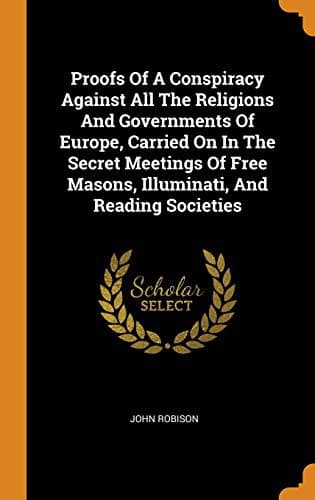
Proofs of a Conspiracy against all the Religions and Governments of Europe: carried on in the secret meetings of Free Masons, Illuminati, and reading societies.Robison, John
History
Proofs of a Conspiracy against all the Religions and Governments of Europe: carried on in the secret meetings of Free Masons, Illuminati, and reading societies.
Robison, John
Freemasonry -- Early works to 1800; Illuminati -- Early works to 1800
professed in them is very flattering to those who have not succeeded
in the scramble for civil distinctions. Such persons become the
most zealous Masons, and generally obtain the active offices in the
Lodges, and have an opportunity of treating with authority persons
whom in public society they must look up to with some respect.
These considerations account, in some measure, for the importance
which Free Masonry has acquired in Germany. For a long while the
hopes of learning some wonderful secret made a German Baron think
nothing of long and expensive journies in quest of some new degree.
Of late, the cosmo-political doctrines encouraged and propagated in
the Lodges, and some hopes of producing a Revolution in society, by
which men of talents should obtain the management of public affairs,
seem to be the cause of all the zeal with which the order is still
cherished and promoted. In a periodical work, published at Neuwied,
called _Algemein Zeitung der Freymaurerey_, we have the list of the
Lodges in 1782, with the names of the Office-bearers. Four-fifths
of these are clergymen, professors, persons having offices in the
common law-courts, men of letters by trade, such as reviewers and
journalists, and other pamphleteers; a class of men, who generally
think that they have not attained that rank in society to which
their talents entitle them, and imagine that they could discharge
the important offices of the state with reputation to themselves and
advantage to the public.
The miserable uncertainty and instability of the Masonic faith,
which I described above, was not altogether the effect of mere
chance, but had been greatly accelerated by the machinations of
Baron Knigge, and some other cosmo-political Brethren whom he had
called to his assistance. Knigge had now formed a scheme for uniting
the whole Fraternity, for the purpose of promoting his Utopian plan
of universal benevolence in a state of liberty and equality. He
hoped to do this more readily by completing their embarrassment,
and showing each system how infirm its foundation was, and how
little chance it had of obtaining a general adherence. The _Stricten
Observanz_ had now completely lost its credit, by which it had hoped
to get the better of all the rest. Knigge therefore proposed a plan
to the Lodges of Frankfort and Wetzlar, by which all the systems
might, in some measure, be united, or at least be brought to a state
of mutual forbearance and intercourse. He proposed that the English
system should be taken for the ground-work, and to receive all and
only those who had taken the three symbolical degrees, as they were
now generally called. After thus guarding this general point of
faith, he proposed to allow the validity of every degree or rank
which should be received in any Lodge, or be made the character of
any particular system. These Lodges having secured the adherence of
several others, brought about a general convention at Willemsbad
Public-domain text, read in full here on John Shaqi.
Reviews
Reviews
No reviews yet
Be the first to share your thoughts on this work.
Join the Discussion
Join the discussion
Sign in to leave a comment or review.
Sign InorCreate an account