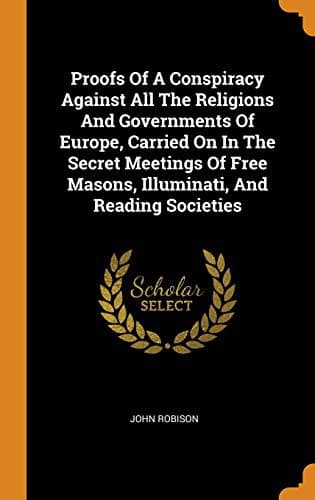
Proofs of a Conspiracy against all the Religions and Governments of Europe: carried on in the secret meetings of Free Masons, Illuminati, and reading societies.Robison, John
History
Proofs of a Conspiracy against all the Religions and Governments of Europe: carried on in the secret meetings of Free Masons, Illuminati, and reading societies.
Robison, John
Freemasonry -- Early works to 1800; Illuminati -- Early works to 1800
"I, N. N. hereby bind myself, by mine honour and good name,
forswearing all mental reservation, never to reveal, by hint,
word, writing, or in any manner whatever, even to my most trusted
friend, any thing that shall now be said or done to me respecting
my wished-for reception, and this whether my reception shall follow
or not, I being previously assured that it shall contain nothing
contrary to religion, the state, nor good manners. I promise, that
I shall make no intelligible extract from any papers which shall be
shewn me now or during my noviciate. All this I swear, as I am, and
as I hope to continue, a Man of Honour."
The urbanity of this protestation must agreeably impress the mind
of a person who recollects the dreadful imprecations which he made
at his reception into the different ranks of Free Masonry. The
candidate is then introduced to an _Illuminatus Dirigens_, whom
perhaps he knows, and is told that this person is to be his future
instructor. There is now presented to the candidate, what they call
a table, in which he writes his name, place of birth, age, rank,
place of residence, profession, and favourite studies. He is then
made to read several articles of this table. It contains, 1_st_, a
very concise account of the Order, its connection with Free Masonry,
and its great object, the promoting the happiness of mankind by
means of instruction and confirmation in virtuous principles. 2_d_,
Several questions relative to the Order. Among these are, "What
advantages he hopes to derive from being a member? What he most
particularly wishes to learn? What delicate questions relative to
the life, the prospects, the duties of man, as an individual, and
as a citizen, he wishes to have particularly discussed to him? In
what respects he thinks he can be of use to the Order? Who are his
ancestors, relations, friends, correspondents, or enemies? Whom he
thinks proper persons to be received into the Order, or whom he
thinks unfit for it, and the reasons for both opinions?" To each of
these questions he must give some answer in writing.
Public-domain text, read in full here on John Shaqi.
Reviews
Reviews
No reviews yet
Be the first to share your thoughts on this work.
Elsewhere in the archive
Join the Discussion
Join the discussion
Sign in to leave a comment or review.
Sign InorCreate an account