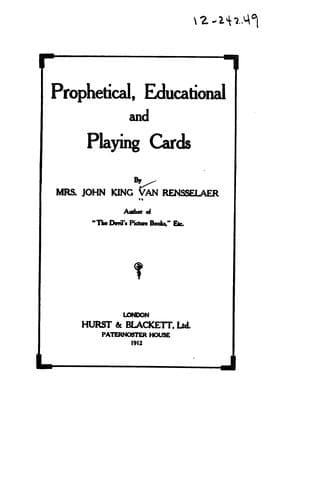
Prophetical, Educational and Playing Cards — John Shaqi
Prophetical, Educational and Playing CardsVan Rensselaer, John King, Mrs.
Religion
Prophetical, Educational and Playing Cards
Van Rensselaer, John King, Mrs.
Fortune-telling by cards -- History; Playing cards -- History
by the reader of the Scriptures to keep the place, since the text is
written in fine characters not easily followed without the pointing finger
of the Yod. The Wheel of Fortune typifies magic power, fortune, expression
of the will of the gods, or their commands, supremacy, superstition, and
luck. Anubis was the conductor of spirits to the judgment seat (or
Mercury, as Chthonius); he also held the balance in the hall of the dead.
He is called "Lord of the Burying-ground," and is represented as a
jackal. The Wheel of Fortune is derived from Osiris, on the judgment seat,
with Anubis as assistant.
XI. LA FORZA (Strength)
This Atout shows a female figure, wearing the mystic hat, or vital sign
[Illustration: infinity symbol], seen on the Pagat, or the first Atout.
The girl forces open the mouth of a lion, expressing vitality, force,
courage, daring. It would seem the ancients believed that, in suffering or
trouble a woman was superior to a man, for endurance and strength of mind.
The figure also typifies innocence, so the fable of Una and the lion seems
to be depicted, whether intentionally or not. Another symbol is that of
the Amazons, who pretended, say modern writers, to great strength, in
spite of being women, but the translations of some of the cuneiform
tablets lead one to suppose that these female warriors were more noted in
their own times for their wit than for their strength. The value given to
the card indicates it to be under the protection of Minerva. The Hebrew
letter for this card is Kaph, which typifies a grasping hand. This card
represents subtle and mystic occultism, with its influence over mankind;
in fact, female charity. It recalls, by its costume and attributes, the
Egyptian goddess Neith, whose temple was at Sais, the chief city of the
Delta. She wears a peculiar emblem on her head, sometimes called a
"shuttle," recalling the device of the Atout. Mr. Rawlinson, in his
"Ancient Egypt" (page 342), says the inscription on her shrine reads: "I
am all that was, and is, and is to be. No mortal hath lifted my veil." The
last expression would be understood in Egypt, for the lifting of the veil
is the conclusion of the marriage service, when the bridegroom sees his
wife for the first time. Therefore, one meaning of the card is a bride.
XII. L'APPESO (The Hanged Man)
Public-domain text, read in full here on John Shaqi.
Reviews
Reviews
No reviews yet
Be the first to share your thoughts on this work.
Join the Discussion
Join the discussion
Sign in to leave a comment or review.
Sign InorCreate an account