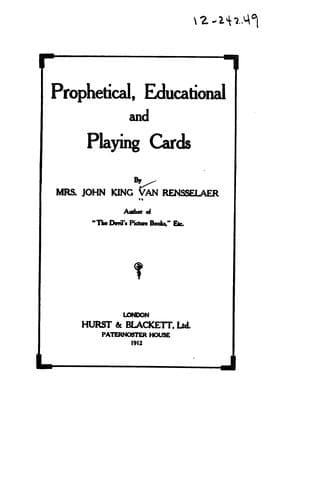
Prophetical, Educational and Playing CardsVan Rensselaer, John King, Mrs.
Religion
Prophetical, Educational and Playing Cards
Van Rensselaer, John King, Mrs.
Fortune-telling by cards -- History; Playing cards -- History
This thirteenth Atout is represented on some cards as a skeleton mowing
off the heads of men, on some as a rider on a white horse, and on others
on a black one. There is an old proverb: "Death comes riding on a white
horse," and sometimes the clouds betokening rain are called "the white
horses of death." One of the horses of Aurora was called Abraxas, the
numerical value of these letters summing up three hundred and sixty-five,
or the number of the days of the year. The occult meanings attached to
this card and its number in the Atouts are well known, for the latter is
connected with bad luck or death in all European countries, and in every
place where the worship of Mercury or the Hermetic art, as connected with
cards, has penetrated. It is not so regarded, however, by savage tribes,
who have not followed this cult. This superstition is, therefore, by many
deemed to be one of the proofs that the cards were descended from those
mysteries. It is supposed that this image of Death was the half-way
position in the temple of Thoth, and therefore divided the Atouts to the
right and to the left, since they were placed in sequence on both sides.
Thoth Hermes, the unnumbered Atout, was represented by a statue that
occupied the centre of the building, under which stood an altar. On this
altar the rods (or pip cards) were thrown when consulting the oracle. At
any rate, the altar (or its remains) occupies the centre of the ruins of
the temple of Mercury, at Baiæ. The central position of Death was deemed
to indicate the dividing period of a man's life. The inquirer, after
consulting the pictured figures, representing the family, religion,
government, and friends of the beginning of his life, now learned of the
more serious affairs of later years, not necessarily death or bad fortune,
but, rather, a transforming force, since this Atout marked such a distinct
epoch in the path of life, and was to be considered most seriously. Still
the card also portends sorrow, destruction, and death. The letter is Mem,
meaning fertility and formation, or the development of the being in an
unlimited space, perhaps regeneration after destruction, or immortality in
another world.
XIV. LA TEMPERAN (Temperance)
It is probable that this figure was intended for Nut or Nephthys. Of her
but little is positively known, and, so far, no temple erected to her has
been discovered. She was called the wife of Seb, and the mother of Osiris.
Her titles are "the Elder," "the Mother of the Gods," and "the Nurse." She
is usually represented as veiled and pouring a liquid from a vase. Her
figure frequently appears in tombs, as if she was the guardian angel or
protector of the dead soul. This idea of an oblation to the gods, through
pouring wine or oil before them, is found to be common among the
Babylonians, and to "pour oil on the troubled waters" is no mere figure of
speech.
Public-domain text, read in full here on John Shaqi.
Reviews
Reviews
No reviews yet
Be the first to share your thoughts on this work.
Join the Discussion
Join the discussion
Sign in to leave a comment or review.
Sign InorCreate an account