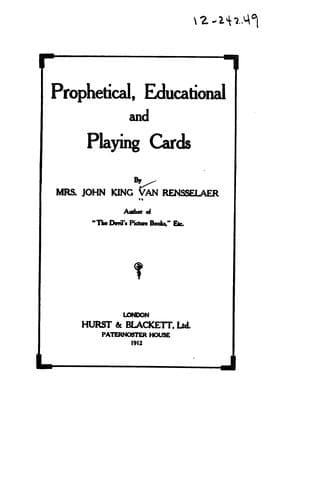
Prophetical, Educational and Playing CardsVan Rensselaer, John King, Mrs.
Religion
Prophetical, Educational and Playing Cards
Van Rensselaer, John King, Mrs.
Fortune-telling by cards -- History; Playing cards -- History
interpreted; the oldest accounts name the chief gods, whose qualities and
symbols later became merged in more modern ones, and they were given
different names at various times, which is most confusing. The great
temple consecrated to Enlil is called E-Kur, and is at Nippur. This name
for this particular tabernacle became the common name for temple in
general (page 411). No king of Babylon ventured to do anything or take
any step without "kissing the hand" of Enlil, to obtain his consent and
approval. According to Doctor Radau, Enlil was afterwards succeeded or
displaced by Marduk (the Merodach of the Bible, and the Jupiter of the
Romans), although the supremacy of Enlil lasted some three thousand five
hundred years, quite long enough to leave an impression on the "Book of
Fate." One of the tablets translated from the Sumerian language has been
given almost literally, and is an invocation to Enlil, bewailing the
destruction and begging for the restoration of the principal cities of
Babylonia, together with the temples that had been destroyed, which were,
in fact, the homes of the priests, who always dwelt in the sanctuaries.
Doctor Radau (page 444) calls the song, "The Lamentation of the Goddess
Nin, of the City of Mar, who was called Nin-Mar." He gives a literal
translation of the cuneiform text of the tablet that has a well-defined
metre, and is divided into sections. The first three verses are an
invocation to Enlil, the supreme god, by this goddess, Nin-Mar, who
declares that she is "Mistress of Mar," who, through the power granted to
her by Enlil, was once able to destroy the enemies of her country and lay
waste their lands, but the power has left her, as her "Master" sleeps.
Nin-Mar gets a sympathetic god, named Nin-ib, to sing a hymn with her, in
which the destroyed temples are recounted. Nin-ib was the solar deity of
Nippur, also a war god, but inclined to be beneficent to mankind. One of
his titles was "the warrior," and he is identified as the planet Saturn.
His symbol was a man with a lion's head.
TO ENLIL.
Oh, Enlil, who placed on the waters
A shelter for men and for all,
Great God, who creates and then slaughters,
Come, hark to the children's call.
Nin-Mar, the smiter of mountains, I sigh, I sigh;
Enlil, to thee I cry, cry, cry.
Shall the Mistress of Mar and his daughters,
His doves and the broods on their nests,
Shall their homes be cast out on the waters,
While their Master is lying at rest?
Nin-Mar, who was the destroyer of lands, I sigh, I sigh;
Enlil, to thee I cry, cry, cry.
Exalted one! Listen to pleadings,
For my Nippur now covers its face;
My E-Kur, my Ki-Ur have vanished,
May all be restored to their place.
It is Mar, the smiter of mountains, I sigh, I sigh;
Enlil, to thee I cry, cry, cry.
THE HYMN.
Public-domain text, read in full here on John Shaqi.
Reviews
Reviews
No reviews yet
Be the first to share your thoughts on this work.
Join the Discussion
Join the discussion
Sign in to leave a comment or review.
Sign InorCreate an account