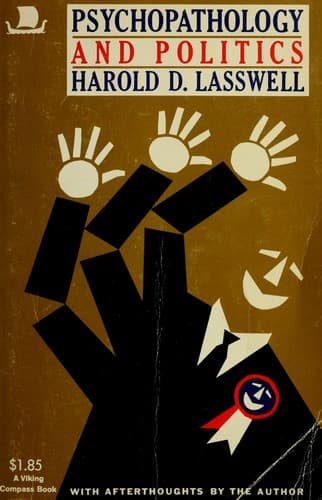
Psychopathology and politicsLasswell, Harold D. (Harold Dwight)
Science
Psychopathology and politics
Lasswell, Harold D. (Harold Dwight)
Personality and politics; Political science; Psychoanalysis; Psychology, Pathological
to shout and write. Their consciences trouble them unless they have
periodic orgies of moral fervor. Relying upon the magic of rhetoric,
they conjure away obstacles with the ritualistic repetition of
principles. They become frustrated and confused in the tangled mass
of technical detail upon which successful administration depends.
Agitators of the “pure” type, when landed in responsible posts, long
to desert the official swivel for the roving freedom of the platform
and the press. They glorify men of outspoken zeal, men who harry the
dragons and stir the public conscience by exhortation, reiteration, and
vituperation.
The first life-history to be excerpted here is that of Mr. A. This is
no “institutional” case. Mr. A is aware of no mental pathology, and
has never consulted a neurologist, psychiatrist, or “nerve doctor.”
He is one of those who at first reluctantly, then whole-heartedly,
allowed himself to be studied with the same thoroughness, intimacy,
and detachment with which an obviously unstable person would be
scrutinized. Mr. A at once saw the advantage for the progress of
science of an accumulation of life-histories taken from men who regard
themselves as perfectly normal, since so much of our case material is
from the ill.
A’s claim to a place among the agitators is not open to question.
He was compelled to resign his position when the United States went
into the World War on account of the tenacity with which he argued
the pacifist position. He had previously run for Congress on the
socialist ticket. Suspected of unorthodoxy in the theological school,
he steadily became more radical in his views, and was expelled from
one denomination. Previously he had been the secretary and principal
spokesman for a civic reform organization which had vigorously attacked
corruption in municipal affairs. He gradually became convinced that
“white collar reforms” were futile as long as the capitalistic system
prevailed in this country, and presently threw his energy into the
propaganda of labor organization and socialism.
A leading characteristic as moralist, socialist, and pacifist has
been his truculence in public on behalf of his cause. Mr. A speaks
rapidly, with great fervor and earnestness, and his discourse
is studded with abusive epithets, sarcastic jibes, and cutting
insinuations. He confesses that he has taken an unmistakable pleasure
in “rubbing the fur the wrong way.” He enjoyed nothing better than
accepting invitations to lecture on social and economic subjects
before conservative audiences, and scandalizing them by declaring that
“organized business and organized crime are hard to distinguish from
one another,” “corruption and capitalism are one and inseparable,” and
“capitalism depends on markets, markets ultimately depend on force, and
force means war.” Thus war was the logical result of the capitalistic
system.
Public-domain text, read in full here on John Shaqi.
Reviews
Reviews
No reviews yet
Be the first to share your thoughts on this work.
Join the Discussion
Join the discussion
Sign in to leave a comment or review.
Sign InorCreate an account