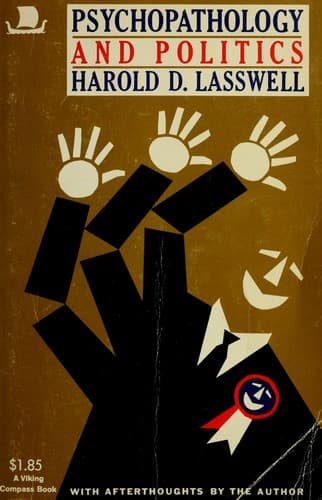
Psychopathology and politicsLasswell, Harold D. (Harold Dwight)
Science
Psychopathology and politics
Lasswell, Harold D. (Harold Dwight)
Personality and politics; Political science; Psychoanalysis; Psychology, Pathological
Upon what does the displacement and the rationalization depend? No
doubt the general answer is that the selection of certain public
objects depends upon the “historical” accident of the patterns offered
by the personal environment of the individual at critical phases
of growth. It is safe to predict that more politicians rise from
families with political traditions than without them. But this very
broad conclusion requires no technique of intensive investigation of
individual instances to support it. If the psychopathological approach
to the individual is worth the trouble, it must disclose a variety of
relatively novel circumstances which dispose individuals to adopt,
reject, or modify the patterns of act and phrase which are offered in
the environment. Provisionally, we may assume that the puberty phase of
biological growth, which coincides with increasing social demands, may
be the period in which the attitudes toward the invisible environment
most rapidly crystallize.
The details may be more hopefully dealt with if somewhat homogeneous
groups of politicians are investigated for the purpose of bringing out
significant differences in their developmental history. The agitators
are the first to whom special attention will be paid.
CHAPTER VI
POLITICAL AGITATORS
The essential mark of the agitator is the high value which he places
on the emotional response of the public. Whether he attacks or defends
social institutions is a secondary matter. The agitator has come by
his name honestly, for he is enough agitated about public policy
to communicate his excitement to those about him. He idealizes the
magnitude of the desirable social changes which are capable of being
produced by a specific line of social action. From the standpoint
of the administrative mind, we may say that an agitator is one who
exaggerates the difference between one rather desirable social policy
and another, much as the lover, according to Shaw, is one who grossly
exaggerates the difference between one woman and another. Whether
agitators behave like physicians or surgeons, as Munro would have it,
they are united in expecting much good to come from single acts of
innovation. The agitator easily infers that he who disagrees with him
is in communion with the devil, and that opponents show bad faith or
timidity. Agitators are notoriously contentious and undisciplined;
many reforming ships are manned by mutineers. The agitator is willing
to subordinate personal considerations to the superior claims of
principle. Children may suffer while father and mother battle for the
“cause.” But the righteous will not cleave to their families when
the field is ripe for the harvest. Ever on the alert for pernicious
intrusions of private interest into public affairs, the agitator sees
“unworthy” motives where others see the just claims of friendship.
Believing in direct, emotional responses from the public, the agitator
trusts in mass appeals and general principles. Many of his kind live
Public-domain text, read in full here on John Shaqi.
Reviews
Reviews
No reviews yet
Be the first to share your thoughts on this work.
Join the Discussion
Join the discussion
Sign in to leave a comment or review.
Sign InorCreate an account