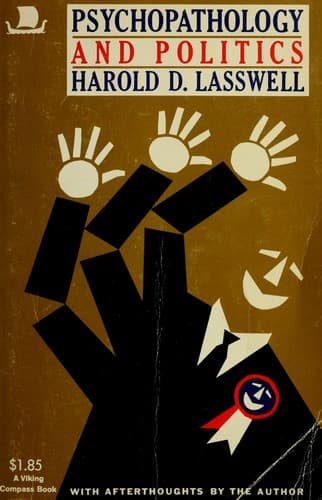
Psychopathology and politicsLasswell, Harold D. (Harold Dwight)
Science
Psychopathology and politics
Lasswell, Harold D. (Harold Dwight)
Personality and politics; Political science; Psychoanalysis; Psychology, Pathological
The father slept in the same bed with his two sons until they were
well along in the teens. For as long as he can remember, A found the
touch of his father very pleasant, though the touch of his brother
was repugnant. A’s strong hostility against his brother, based on
their rivalry for the affections of the father, received a certain
justification in the critical episode which occurred as his older
brother, who matured early, approached puberty and began to have
emissions. The preacher was horrified, for he took this as a sign of
masturbation, and masturbation was sinful and dangerous.[31] When he
thought that A was sound asleep, he would gravely lecture the older
boy on the evil consequences of self-abuse. Sometimes the son would
wake up in the morning and discover that an emission had taken place
during the night. In a hushed and contrite whisper he would say to
his father, “I’ve gone and done it again!” at which the parent would
exclaim reproachfully, “Oh!” The boy was presently taken to a physician
who seems to have modified the excitement of the father and in some
measure to have reassured the son that his manhood was not irreparably
lost. Dark rumors about self-abuse were whispered through the village
from time to time. The neighborhood idiot was supposed to have brought
idiocy upon himself by self-abuse, and a bachelor in the village who
went insane was supposed to have suffered from the same vice.
A listened to the rumors and to the nocturnal dialogues between his
father and elder brother, and gathered that ominous things were
connected with handling one’s self. He felt ashamed of his brother, who
brought so much suffering on his father, and silently determined never
to be a disappointment to his father. The tag end of a biblical passage
about bringing the gray hairs of his father to the grave in shame
ran through his mind, and he resolved never to repeat his brother’s
weaknesses.
A’s older brother surprised everybody about this time by suddenly
changing from a phlegmatic lad into a fervent religious enthusiast. He
became converted under dramatic circumstances and joined the church,
thus propitiating the unknown powers which might visit horrible
punishment upon him for his private iniquities. In this he was running
true to the adolescent pattern. Adolescence is notoriously the time
when the temptations of the “flesh” multiply and when many youths,
oppressed by their “animal” impulses, seek to escape from the burden
of guilt by adopting the ceremonial patterns provided in the religious
observances of society. Adolescence is so often a period of high
ideals, which are typically reaction formations to “low desires,” that
adolescence is the happy hunting ground for proselyters of every breed.
Public-domain text, read in full here on John Shaqi.
Reviews
Reviews
No reviews yet
Be the first to share your thoughts on this work.
Join the Discussion
Join the discussion
Sign in to leave a comment or review.
Sign InorCreate an account