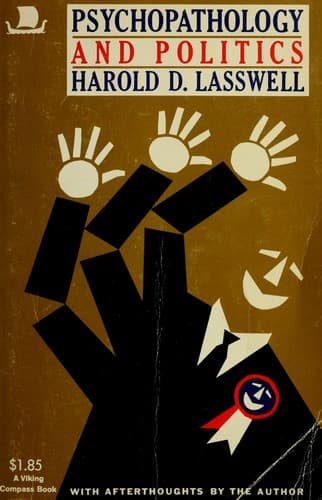
Psychopathology and politicsLasswell, Harold D. (Harold Dwight)
Science
Psychopathology and politics
Lasswell, Harold D. (Harold Dwight)
Personality and politics; Political science; Psychoanalysis; Psychology, Pathological
Just before graduating from college A had a talk with a favorite
professor. The professor asked him what he proposed to do, and was
much interested when A said that he wanted to become a minister. The
professor said that during his own active years in the pulpit, before
he began to teach, he had learned at least one thing. Every man who was
intellectually honest and independent would sooner or later discover
that he questioned his own dogmas, and a period of bitter anguish would
ensue. If a man were intellectually honest, he would never flinch from
the truth, even for the sake of wife and family. But when the period
of doubt arose he advised A not to abandon his work too abruptly. He
had himself lived through six months of torture during which he had
been on the verge of dropping everything and going into business. But
finally he had arrived at a faith which he could defend, and stuck
to it. “I would rather be drawn and quartered than preach anything I
do not believe,” he declared emphatically. This conversation made a
deep impression upon A, leading him to anticipate doubts as a mark of
intellectual keenness and honesty.
Thus far in his life he had never questioned the tenets of the strict
and simple theology of his immediate surroundings. Indeed, he had never
met anybody who questioned it. Only a single episode had slightly
jarred his complacency and left a tiny scar behind. At one time his
Sunday-school teacher had been a young professor of theology who was
much more liberal than his contemporaries. A boy in the class had dared
to ask something about the authority of the Bible, and the teacher,
without the least trace of embarrassment, had replied that authority
should not rest on blind faith but upon clear reason. “If the Bible
told you to kill your father and your mother, you would not do it. You
would not be bound to do it. The justification of the Bible is that its
teachings prove to be sound in the experience of all reasonable men.”
In the divinity school the first course which A attended was on the
authority of the Bible. It was taught by a smug and full person of some
eminence. A was accustomed to distinguish himself by bold opinions,
and he undertook to challenge several of the propositions which were
supposed to be accepted and repeated by rote. His main point was
that authority rested on reason, not on faith. For his pains he got
the reputation of being a smart and troublesome upstart of doubtful
orthodoxy. His former Sunday-school teacher was a member of the
faculty, and A wrote a thesis on the authority of the Bible, in which
he elaborated the line of argument which had so much impressed him.
Only the constant intercession of this professor kept A from being
disciplined, or even expelled, at various times.
Public-domain text, read in full here on John Shaqi.
Reviews
Reviews
No reviews yet
Be the first to share your thoughts on this work.
Join the Discussion
Join the discussion
Sign in to leave a comment or review.
Sign InorCreate an account