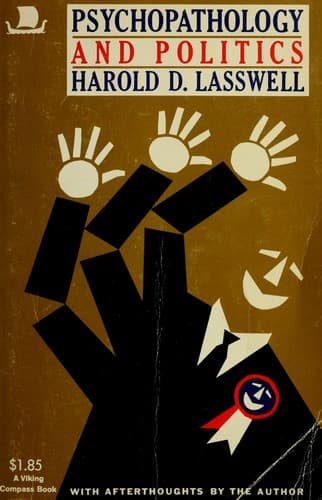
Psychopathology and politicsLasswell, Harold D. (Harold Dwight)
Science
Psychopathology and politics
Lasswell, Harold D. (Harold Dwight)
Personality and politics; Political science; Psychoanalysis; Psychology, Pathological
Another significant private motive, whose organization dates from early
family days, but whose influence was prominent in adult behavior, was
A’s struggle to maintain his sexual repressions. He erected his very
elaborate personal prohibitions into generalized prohibitions for all
society, and just as he laid down the law against brother-hatred, he
condemned deviations from the rigid puritanical code by which he lived.
Individuals who possess superego structures of such rigor often try to
protect themselves from the strain of sexual excitement by keeping away
from “temptation,” or by removing “temptation” from their environment.
Thus Mr. A avoided exposing himself to “lewd speech” and “immoral
suggestion.” Consciences of such severity can often be traced back
in deeply analyzed cases to unusually strong repressions at the time
when infantile masturbatory activities are being curbed. And it often
happens that the rôle of the intimidator is taken not only by the male
but by the female imago. In another highly moralistic person, who was
thoroughly psychoanalyzed, this came out distinctly. Thus for several
days the subject dreamed of standing before a butcher shop where he
had been sent by his mother, and where he saw his father sharpening
long knives. Or he saw his mother, dressed as Brünnhilde, carrying a
sword, while he cowered on a marble stairway. After many dreams of this
kind, the original situations finally burst into view. They involved
what were interpreted as direct threats to cut off a hand if the child
didn’t cease handling himself.
That A was never able to abolish his sexuality is sufficiently evident
in his night dreams and daydreams. In spite of his efforts to “fight”
these manifestations of his “antisocial impulses,” they continued
to appear. Among the direct and important consequences which they
produced was a sense of sin, not only a sense of sexual sin, but a
growing conviction of hypocrisy. His “battle” against “evil” impulses
was only partially successful, and this produced a profound feeling of
insecurity.
This self-punishing strain of insecurity might be alleviated, he found,
by publicly reaffirming the creed of repression, and by distracting
attention to other matters. A’s rapid movements, dogmatic assertions,
and diversified activities were means of escape from this gnawing
sense of incapacity to cope with his own desires and to master
himself. Uncertain of his power to control himself, he was very busy
about controlling others, and engaged in endless committee sessions,
personal conferences, and public meetings for the purpose. He always
managed to submerge himself in a buzzing life of ceaseless activity;
he could never stand privacy and solitude, since it drove him to a
sense of futility; and he couldn’t undertake prolonged and laborious
study, since his feeling of insecurity demanded daily evidence of his
importance in the world.
Public-domain text, read in full here on John Shaqi.
Reviews
Reviews
No reviews yet
Be the first to share your thoughts on this work.
Elsewhere in the archive
Join the Discussion
Join the discussion
Sign in to leave a comment or review.
Sign InorCreate an account