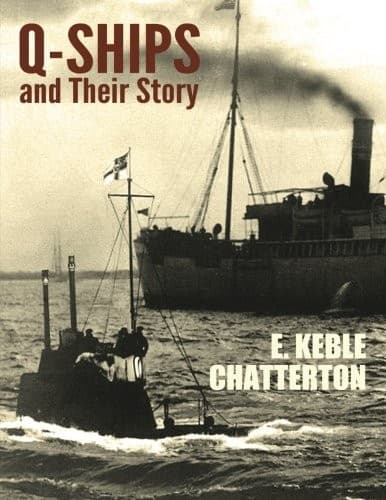
Q-Ships and Their StoryChatterton, E. Keble (Edward Keble)
History
Q-Ships and Their Story
Chatterton, E. Keble (Edward Keble)
Q-ships; World War, 1914-1918 -- Naval operations
see the “accident,” we did not waste much time on it, but let her go
down right side up. Away went the skipper and his crew, and he admits
feeling lonely with a hostile submarine near by and the ship and her
guns working away from him. He says he was struck with the beauty of
her lines, and she never appeared more attractive to him. As a matter
of fact, his was a rotten position, which was not improved by the sub.
firing at him two or three shells, which went over and short. Evidently
the submarine, which by the way had closed to 1,000 yards as soon as
the boat left the ship, wanted him to pull towards it, instead of which
he was digging out after us manfully. Meanwhile the ship appeared quite
deserted. Everyone was concealed. The C.O. prowled around the deck on
his hands and knees, peering through cracks and rivet holes in the
bulwarks to see how the submarine was getting on. All I could see of
him was the stern position of his body and the soles of an enormous
pair of clogs. I sat on deck at the wheel, trying to get and keep the
ship in the wind, so as not to get too far from the boat. All this
time the submarine was firing steadily, and one shell went through the
mizzen, while others, as the C.O. reported from time to time, burst
short, some of them close. Splinters from the latter went through the
stay- and fore-sails. At 1,000 yards the ship is a fairly big target,
and the shooting of the Huns must be put down as bad.
‘It is all very well serving as a target at 1,000 yards, but it is an
experience which must not be too long continued in case a lucky shot
disables one. In the present case, moreover, the wind and sea were
rapidly increasing, and we were leaving the boat in spite of all our
efforts to stop. The submarine seemed quite determined not to come any
nearer, and the C.O. decided that the moment had come for our side to
begin. Just before this one of the bulwarks, luckily on the side away
from the sub., had fallen down, and let a deluge of water on to the
decks, but this did not affect things as far as we know.
‘At the word, down fell the bulwarks, round came the guns, and up
went the White Ensign. Only the after 12-pounder gun would bear. The
first shell struck the submarine at the junction of the conning-tower
and deck forward. The 6-pounder also fired one shell, and hit the
conning-tower. The second shell from the big gun burst short. By the
time the smoke had cleared away the submarine had disappeared. Had we
sunk her or had she dipped? This is the point which is exercising our
minds. The C.O. thinks the evidence of sinking her is not conclusive,
but most of us think she has gone down for ever.
‘We then made for the boat, which was still labouring after us, and got
it hooked on and hoisted. There was quite a decent-sized sea, and the
hoisting process was not very pleasant for those left in to hook on,
not to mention that they got wet from the exhaust.
Public-domain text, read in full here on John Shaqi.
Reviews
Reviews
No reviews yet
Be the first to share your thoughts on this work.
Join the Discussion
Join the discussion
Sign in to leave a comment or review.
Sign InorCreate an account