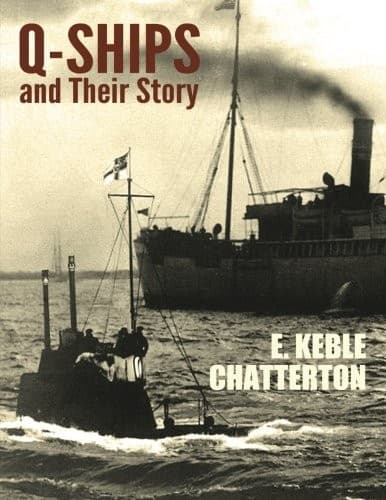
Q-Ships and Their StoryChatterton, E. Keble (Edward Keble)
History
Q-Ships and Their Story
Chatterton, E. Keble (Edward Keble)
Q-ships; World War, 1914-1918 -- Naval operations
On February 9 _Result_ was all ready as a warship, and motored out
of Lowestoft. She then disguised herself as a neutral, affixed Dutch
colours to her topsides, and proceeded via Yarmouth Roads to the
neighbourhood of the North Hinder, the other side of the North Sea,
where the enemy was very fond of operating. On the fifteenth of the
following month _Result_ was cruising off the south-west end of the
Dogger Bank when she encountered UC 45 in the morning. Lieutenant
Muhlhauser, who was kind enough to give me his account of the incident,
has described it with such vividness that I cannot do better than
present the version in his own words. It should be added that at the
time _Result_ was steering E.S.E., and was now in the position Lat.
54.19 N., Long. 1.45 E. The submarine was sighted 2-1/2 miles astern,
the wind was northerly, force 5 to 6, the sea being 4 to 5 and rapidly
rising. In other words, it was a nasty, cold North Sea day, and one in
which it would have been most unpleasant to have been torpedoed. The
engagement was a difficult one, as the ship had to be manœuvred so that
her guns would bear, and careful seamanship had to be used to prevent
her lying in the trough of the sea. As it was, with bulwarks down, the
decks and gun-wells were awash and frequently full of water, while the
submarine, being only occasionally visible when _Result_ was on the top
of the sea, made a target that was anything but easy.
‘By 7 a.m.,’ says Lieutenant Muhlhauser, ‘we had got all the topsails
off her, and at this moment the C.O. appeared on deck and, looking
aft, said, “Why, there is a submarine!” and at the same moment it was
reported from aloft. Word was passed to the watches below to stand by.
In a few minutes came the report of a gun. I do not know where the
shell went. The men ran to their stations, or crawled there according
to what their job was, and the ship was brought on the wind. The
submarine continued firing at the rate of a shell every minute or
thereabouts. The C.O. then ordered the jibs to be run down, and while
this was being done a shell stranded the foretopmast forestay, but
luckily did not burst. It went off whistling. Some of the shells were
fairly well aimed, but the bulk were either 50 or 60 yards short or
over, and at times more than that. As the submarine kept about 2,000
yards off, the C.O. ordered the boat away, with the skipper in charge.
Four hands went with him. He was reluctant to go, I think, though, as
a matter of fact, he ran quite as much risk as did those remaining
on board, if not more, as he would have been in an awkward position
if by any chance the ship worked away from him and the submarine got
him. It would have been a hard job to persuade the submariners that
he was anything but British. However, off he went in a nasty sea.
In lowering the boat we made efforts to capsize her, but she was
difficult to upset, and as the sub. was some way off and unlikely to
Public-domain text, read in full here on John Shaqi.
Reviews
Reviews
No reviews yet
Be the first to share your thoughts on this work.
Join the Discussion
Join the discussion
Sign in to leave a comment or review.
Sign InorCreate an account