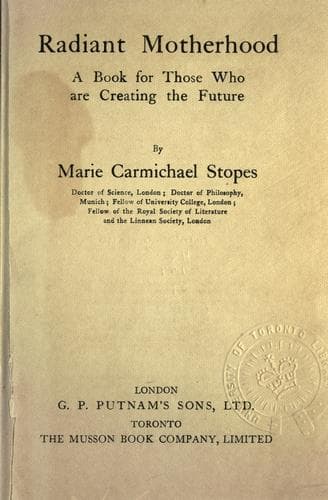
Radiant Motherhood: A Book for Those Who are Creating the FutureStopes, Marie Carmichael
Science
Radiant Motherhood: A Book for Those Who are Creating the Future
Stopes, Marie Carmichael
Mothers
From the moment of the fusion of the nuclei of the male and female
cells, active changes and nuclear divisions are in progress. The egg
cell, which is free, travels slowly to the allotted place in the womb
or uterus of the mother, and there it settles down in the tissue of the
wall and attaches itself. Until it has attached itself firmly to the
wall of the uterus, conception proper has not finally taken place, and
a fertilized egg cell may be lost through want of a capacity to attach
itself to the womb, or through some nervous or other disturbance of the
walls of the womb, which throw it off after it has been attached. The
distinction between the actual moment of fertilization (or union of the
male and female nuclei) and of the final attachment which secures true
conception is an important one, though frequently overlooked. Sometimes
the failure to conceive a child may not at all be due to lack of
fertility and readiness to unite on the part of the egg cell and sperm
cell, but may be due to some nervous or other influence on the wall of
the uterus, which consequently throws off the ovum before it has firmly
settled into its place there.
A few days after conception, and when the ovum has attached itself
to the proper place, a definite zone of tissue begins to form which,
growing and altering with the growth of the tiny developing child
(which is now called the embryo), forms a medium of transmission
between it and the mother through which pass the substances used and
excreted by the embryo in its growth.
After fertilization, intense and rapid activity takes place in
the nuclei of the cells, first in the united nucleus of egg and
sperm cell, and later in the nuclei of all the resulting division
cells. The nucleus of the sperm cell is supposed to contain twelve
chromosomes which go through a formal rearrangement and mingling with
the corresponding chromosomes in the egg cell. As a result of the
complete fusion and intermingling of the male and the female factors
on fertilization, all the resulting divisions of cells which follow
derive their nuclei partly from the male and partly from the female
nucleus of the parents. Thus, if it were possible to trace the history
of every tissue cell in the body of your child, we should see that each
nucleus of all the myriads that compose its structure would ancestrally
consist of part of the many sub-divisions of the nuclei of both father
and mother. Thus to speak of one side of the body as being male in its
inheritance and the other female, is the most unmitigated nonsense,
though this idea formed the basis of a recent book.
Public-domain text, read in full here on John Shaqi.
Reviews
Reviews
No reviews yet
Be the first to share your thoughts on this work.
Elsewhere in the archive
Join the Discussion
Join the discussion
Sign in to leave a comment or review.
Sign InorCreate an account